
Approve a bulk truck building-set pack change only after reconciling the proposed pack with the approved connection mechanism, variant, piece inventory, sales unit and packaging revision. For US/EU importers buying truck building sets in bulk, a different box can change what counts as one sellable set, how instructions reach the builder and how units are recorded per carton. Approve matching revisions, reject unacceptable substitutions, or issue conditional approval that clearly limits what may proceed.
The review is an order-control exercise, not a declaration of regulatory compliance. Its purpose is to establish exactly what the buyer accepts and which documents must change before production or shipment release.
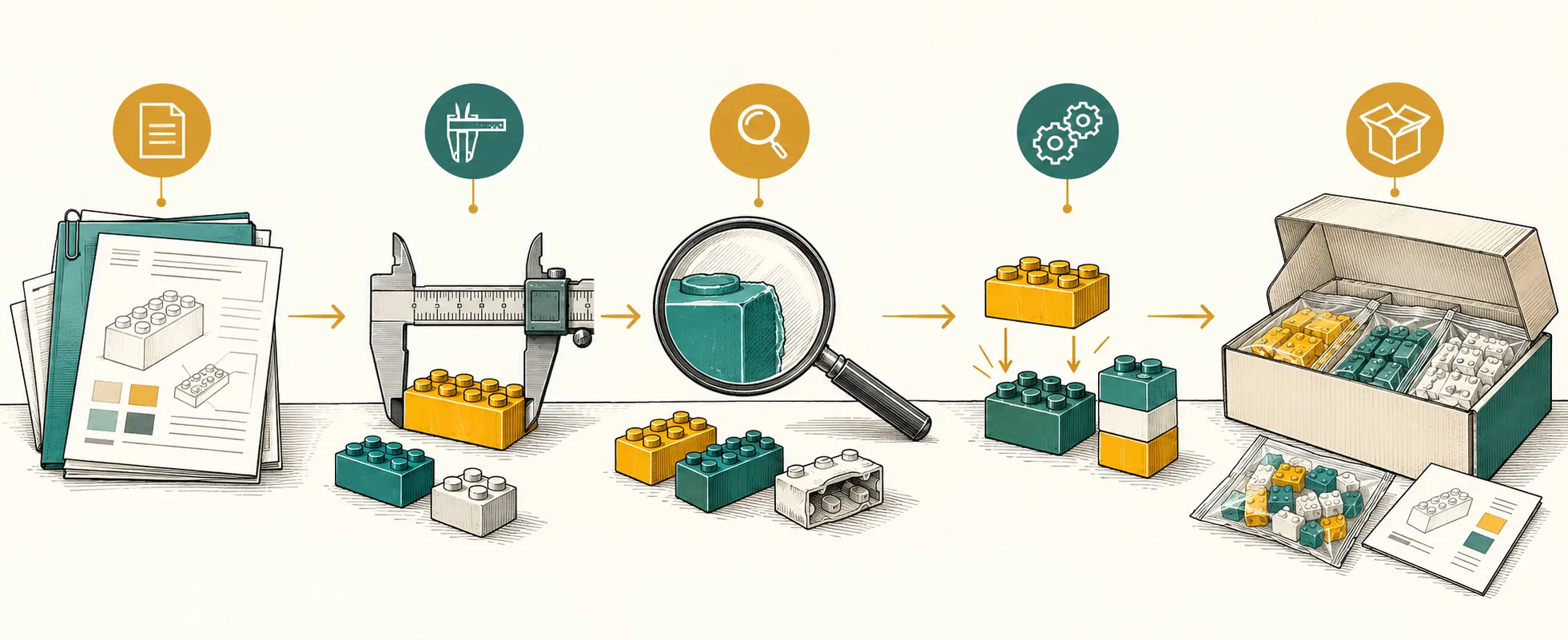
Which product and pack fields must remain aligned?
Keep the construction mechanism and exact truck variant anchored to the approved specification, then review every field affected by the pack proposal. A packaging change does not, by itself, authorize a different connection system, material, model assortment or piece inventory.
Identify whether the product uses interlocking bricks, magnetic connections or another approved construction mechanism; “truck” describes the theme, not the connection system. For a multi-model assortment, establish whether the advertised models can be built together or are alternative builds using shared pieces. That distinction belongs in the specification, artwork and instructions.
Separate three quantities: pieces inside a complete set, sales units ordered, and sales units per master carton. Piece count is not order quantity or MOQ. A recorded carton quantity is not automatically an order multiple, and parcel or retail-box dimensions are not master-carton dimensions.
Request a marked-up proposal showing both changed and unchanged fields. A statement such as “new box, same product” is too broad to serve as the approval boundary.
Which documents should the buyer review before approving the change?
| Product specification and piece inventory — pre-PO baseline or order amendment | Owner: supplier product team prepares; importer product or purchasing lead accepts. Useful fields: buyer/supplier item cross-reference, connection mechanism, truck variant, material specification, element descriptions and counts, accessories, complete-set definition and revision. Mismatch consequence: the pack may describe a different build or an incomplete sales unit. Revise this document if the contents change. |
|---|---|
| Draft packaging and packing configuration — before pack approval | Owner: supplier packaging team prepares; importer packaging or merchandising lead approves. Useful fields: artwork revision, packaging type, model images, piece-count statement, sales units per retail/display pack, inner packs, sales units per master carton, proposed carton dimensions and weights, and destination version. Mismatch consequence: artwork, warehouse counting and the agreed pack hierarchy can describe different units. |
| Instruction file — before approval of the affected packed sample | Owner: supplier product team maintains; importer product reviewer accepts. Useful fields: file revision, model coverage, parts list, build sequence, destination language version, printed or digital delivery method, and placement inside the sales unit. Mismatch consequence: a correctly counted set may still arrive with instructions for another variant or with instructions available only to the display-carton purchaser. |
| Packed-sample approval record — before production release | Owner: supplier identifies the submitted sample; importer reviewer records observations and acceptance. Useful fields: sample identifier, date, referenced specification/artwork/instruction revisions, unpacking photographs, observed contents, observed sales-unit structure, measurements and deviations. Mismatch consequence: approval may refer to a sample that does not represent the proposed production pack. This commercial check is not a substitute for safety testing. |
| Quotation, PO and supplier acknowledgment — before commitment or amendment acceptance | Owner: supplier sales team owns the quote and acknowledgment; importer purchasing owns the PO. Useful fields: item and revision, price basis per defined sales unit, order quantity, packing configuration and accepted change reference. Mismatch consequence: the parties can agree on a number while meaning different quantities of complete sets. Update affected terms rather than relying on an artwork attachment alone. |
| Technical evidence review — when the change affects relevant construction, labeling or claims | Owner: importer’s responsible technical reviewer assesses applicability; supplier provides item-linked documents and report references. Useful fields: product/model identification, tested construction, sample description, applicable destination, proposed changes and the reviewer’s conclusion. Mismatch consequence: an existing report may not address the changed construction or claim. Keep a supplier certification statement open until reviewed; do not treat it as verified compliance. |
| Pack-change decision record — before the authorized activity proceeds | Owner: importer’s designated approver; supplier acknowledges the accepted revision. Useful fields: affected item/order, baseline revision, proposed revision, approve/reject/conditional decision, permitted activity, conditions, responsible people, signatures or recorded acceptance, dates and closure evidence. Mismatch consequence: different teams may act on different versions. |
| Final commercial invoice and packing list — shipment stage | Owner: supplier shipping/accounts team prepares; importer operations reconciles. Useful fields: order and item references, actual sales-unit quantities, carton identifiers and counts, contents by carton, and actual weights and dimensions where used. Mismatch consequence: receiving records may not reconcile with the approved order. Before the PO, agree the required fields and format—not a final packing list for goods that have not yet been packed. |
How can a recorded truck-set pack become a reviewable example?
Use the catalog entry as a starting reference, then establish a signed order baseline before judging the proposed change. A recorded 4-in-1 car-and-truck building set is described as plastic, with 1,152 pieces, display-box packing and 128 units per carton. Those are catalog entries, not proof of the current packed contents or a definition of what one recorded “unit” contains.
For the illustrative worksheet below, suppose approved specification A adopts those recorded values and expressly defines one sales unit as one complete 1,152-piece set. Supplier proposal B requests a color box instead of a display box and states that the variant, sales unit and carton quantity will remain unchanged. This is a hypothetical review, not an account of a completed order.
The status labels describe the document comparison: confirmed means the compared documents agree; changed means a difference is declared; open means the stated acceptance evidence still needs review. Documentary agreement alone does not confirm physical contents.
What does the field-by-field pack-change worksheet show?
| Item identity, connection mechanism and variant | Approved target: exact item, connection mechanism and 4-in-1 variant in specification A and its approved sample reference. Proposed/observed: proposal B states no substitution. Status: confirmed at document level. Evidence/action: carry the same identifiers into the revised specification and check the proposed packed sample against the approved product. |
|---|---|
| Piece inventory | Approved target: one complete 1,152-piece set, with element quantities controlled by specification A’s inventory. Proposed/observed: proposal B repeats the total but does not establish element-by-element agreement. Status: open. Evidence/action: reconcile the revised inventory and unpacked sample, including wheels, axles, connectors and other listed accessories. A matching total alone cannot establish a matching build. |
| Sales unit and assortment use | Approved target: one complete set per sales unit under specification A. Proposed/observed: proposal B retains that definition. Status: confirmed at document level. Evidence/action: preserve the definition in the revised quote, PO acknowledgment and artwork; verify that each independently sold box contains its required contents and instructions. |
| Packaging type | Approved target: display box under specification A. Proposed/observed: color box requested in proposal B. Status: changed. Evidence/action: issue revised artwork and packing configuration with model images, piece statement and sales-unit definition aligned to the accepted set. |
| Sales units per master carton | Approved target: 128 sales units under the example’s specification A. Proposed/observed: proposal B claims the quantity remains 128 despite the new box. Status: open. Evidence/action: supply a trial-pack record that identifies the counted sales units and pack arrangement. Do not assume the new box preserves the previous carton configuration. |
| Master-carton dimensions and weights | Approved target: the carton requirements referenced by specification A’s packing configuration. Proposed/observed: the proposed color-box arrangement requires its own packing observation. Status: open. Evidence/action: record the trial-packed master carton’s measurements and weights against the agreed targets; do not substitute retail-box or parcel dimensions. |
| Instruction revision and delivery | Approved target: specification A’s instruction revision and complete-set coverage. Proposed/observed: a packaging change is requested without an accepted instruction-placement check. Status: open. Evidence/action: review the instruction file against the retained variant, check parts-list agreement and build sequence, and confirm instructions accompany each sales unit. |
| Technical evidence applicability | Approved target: the item-linked evidence references accepted for specification A. Proposed/observed: proposal B describes a pack change, not a completed applicability assessment. Status: open. Evidence/action: have the responsible reviewer assess the actual changes and destination version. A supplier declaration alone does not close this row. |
| Commercial and approval references | Approved target: quotation, PO or baseline approval referencing specification A and its sales-unit definition. Proposed/observed: proposal B requires acceptance of a new packaging revision. Status: changed. Evidence/action: revise affected commercial references and attach the pack-change decision; retain both the superseded baseline and accepted revision. |
When should the buyer approve, reject or conditionally approve?
Approve when the accepted specification, proposed pack, relevant observations and affected order documents agree; reject an unacceptable change; use conditional approval only when its permitted scope and closure requirements are explicit.
Reject, for example, a proposal that removes required pieces or replaces the agreed truck variant when those changes are commercially unacceptable. That decision does not require alleging supplier dishonesty or predicting a future failure.
For the worksheet example, conditional approval permits artwork preparation—not production or shipment. The open inventory, carton, instruction and technical-review rows must be closed before the buyer authorizes the revised pack for production. If a buyer chooses a different release boundary, write that boundary into the decision rather than leaving “conditional” undefined.
Do not order a new report merely because a box revision, internal item number or later batch exists. Review tested construction and report coverage, the actual changes, applicable retest duties and buyer or retailer policies separately.
What must the approval and closure record contain?
| Identity and revision | Record the buyer and supplier item references, affected PO line if an order exists, destination version, approved specification A, supplier proposal B, sample identifier and all affected attachment revisions. For a pre-PO review, use the inquiry or project reference instead of inventing a PO number. |
|---|---|
| Decision and authorized scope | Illustrative outcome: CONDITIONAL—revised artwork preparation only. No production or shipment release under proposal B. The approved product mechanism, variant and complete-set definition remain unchanged. |
| Conditions and revised documents | Close the open worksheet rows using the reconciled piece inventory, trial-carton record, accepted instruction revision and technical-review conclusion. Revise the packaging/packing configuration, affected commercial references and packed-sample approval record. Retain documents judged unchanged with a recorded reason. |
| Responsible approver and decision date | Assign the importer’s authorized purchasing or product approver by full name and role, and record the actual decision date. Identify the supplier contact responsible for acknowledging the accepted revision. A department name alone is not the final sign-off. |
| Condition owners and due dates | Name the supplier owner for each submission and the importer reviewer for each acceptance. Set agreed due dates for the open inventory, carton, instruction and technical-review items; do not substitute a generic production schedule for these closure dates. |
| Closure and release | For each condition, record the submitted file or sample reference, target versus observation, accepted deviation if any, reviewer’s name and closure date. The authorized approver then records whether production may proceed and which revision is released. Reopen the decision if the submitted evidence changes the agreed scope. |
What should be checked again when the shipment is packed?
At shipment stage, reconcile the actual packed goods and final invoice and packing list to the released revision, rather than repeating the pre-PO approval on paper. Check the sales-unit definition, quantities, carton contents and identifiers, and the actual packing measurements used in shipment records.
A different final carton count is not automatically a product change: it may reflect the actual order quantity or an agreed partial carton. Investigate the specific discrepancy without assuming full-carton ordering was required.
Keep the approved revision and closure evidence accessible to receiving staff. The record supports traceability, but it cannot by itself detect an undisclosed substitution; observations of the actual packed goods remain a separate control.