
Choose a depth-led building-toy range when your priority is maintaining stock behind a few established items; choose broader assortment coverage when you need distinct buying options and can manage each SKU separately. Under a fixed budget, SKU depth versus assortment breadth is a choice between concentrating stock and spreading it. Neither structure is universally better. Make the decision using SKU-level demand, packing, instruction quality, storage requirements, and reorder assumptions—not the number of products pictured in a catalog.
Here, depth means more units behind fewer separately orderable SKUs; breadth means more separately orderable SKUs. Count separately stocked variants consistently in both plans. RitePrep describes the underlying budget trade-off as buying a little of many products or a lot of a few. That is a planning principle, not evidence that either structure will sell better. RitePrep
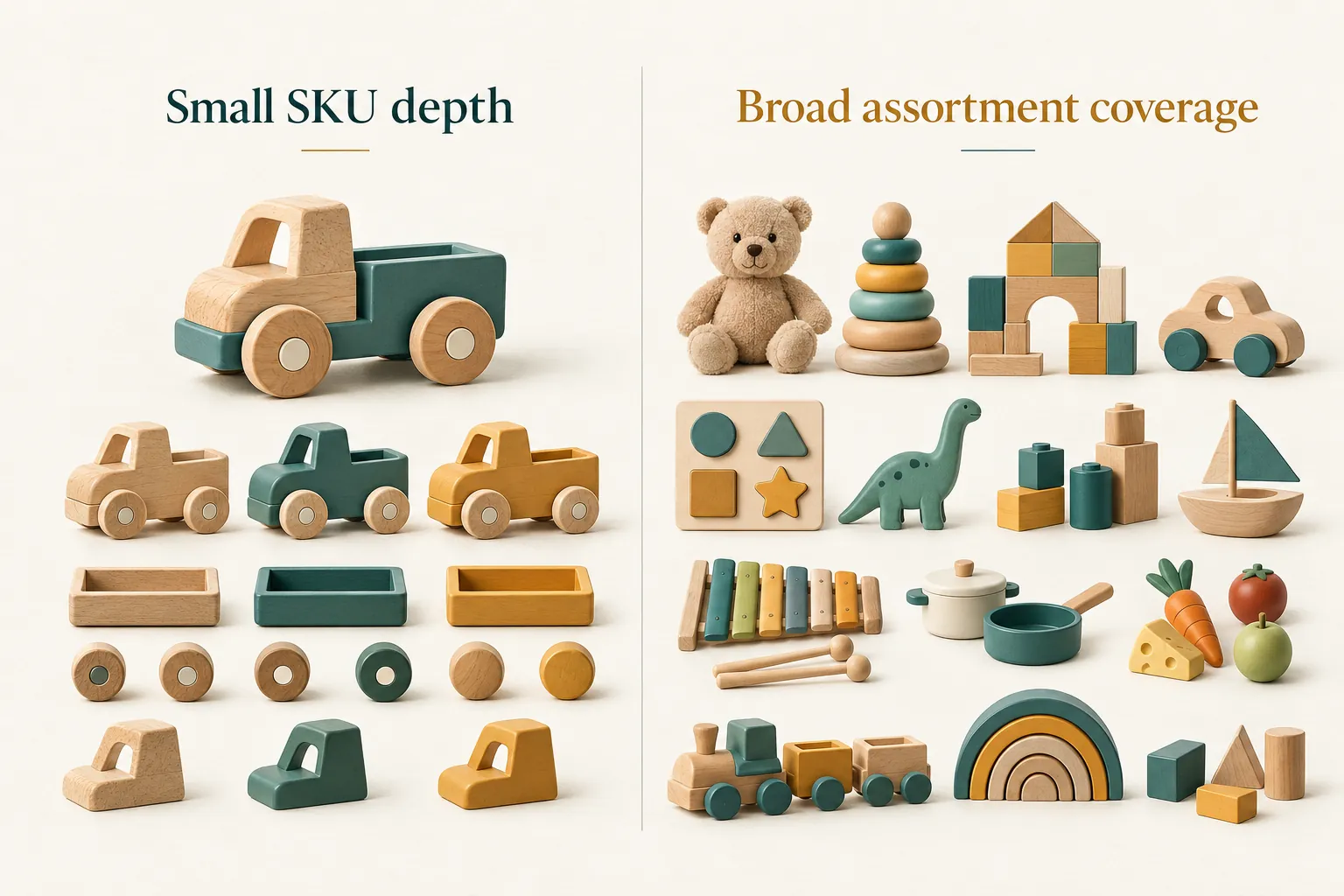
How do depth and breadth change the buying operation?
| Commercial mechanism | Depth: allocate more of the budget to each selected SKU, accepting greater exposure if one item underperforms. Breadth: allocate budget across more choices, accepting less stock behind each item. Compare stock cover using each SKU's own demand assumption; more units do not automatically mean longer cover. |
|---|---|
| Range mechanism | Depth: specify the core item precisely and keep its approved construction and pack identity stable. Breadth: give each addition a defined role, such as a different build format or catalog-listed play function. A new color alone should not be counted as a new buying need without a channel reason. |
| Retail and master packing | Depth: check whether larger quantities fit the intended storage and replenishment arrangement. Breadth: reconcile retail packs, display packs, mixed-item permissions, and master-carton quantities across more lines. Neither structure inherently needs stronger cartons; specify protection for the actual contents and shipment. |
| Instructions and documentation | Depth: maintain an approved product record, instruction revision, packing specification, and sample reference for each core SKU. Breadth: maintain the same controls for every added item. Group documents only where their stated scope actually covers the relevant variants. |
| Operating assumptions | Depth: justify the concentrated commitment with item-level demand and an inventory limit. Breadth: budget the storage locations, listings, photography, sample reviews, and staff attention needed for the added lines. Do not assume that more choices require less work because quantities are smaller. |
| Reorder logic | Depth: define replenishment triggers for the core items. Breadth: assign each item a replenish, continue testing, or exit decision. A first-order sellout is a review trigger, not automatic proof that the next purchase should be larger. |
| Evidence before commitment | For either structure, distinguish the supplier's quoted specification, the buyer's sample observation, and the buyer's planning assumption. Approve the order against all three rather than treating a catalog description as a sample result. |
What does a two-candidate building-toy comparison reveal?
| Four-in-one car-and-truck building set | Catalog description: 1,152 pieces; plastic; display-box packing. Reference MOQ: 20 units. Recorded units per carton: 128. Proposed depth-led role: a core vehicle-building item. Before approval, confirm what the four-in-one description includes, how the display box relates to the sellable unit, and whether the instructions match the supplied contents. |
|---|---|
| Two-in-one pull-back racing-car building set | Catalog description: plastic; pull-back function; color-box packing. Reference MOQ: 20 units. Recorded units per carton: 36. Proposed breadth-led role: an additional vehicle option with a catalog-listed pull-back function. Review the sample's assembly instructions and operation separately from the first candidate. |
How should these candidates change the range decision?
Keep the four-in-one set as a depth candidate if the buying priority is replenishing that approved item; add the pull-back set as a breadth candidate only when its distinct role survives sample and channel review.
The two references have the same minimum quantity but different packing descriptions and recorded carton quantities. That makes them different receiving and presentation proposals even before demand is considered. Confirm whether “display box” describes a single sellable package or a display holding several sellable units. Obtain a packing diagram or photographs showing the unit, display, and master-carton hierarchy.
Do not interpret the 1,152-piece description as an order quantity, or the recorded carton quantity as a compulsory order multiple. Request the permitted order increments and any mixed-carton conditions explicitly. Also request master-carton dimensions and gross weight; an item or retail-package measurement is not a substitute.
These catalog references do not establish current stock, certification, suitability, or operating performance. Check the proposed construction and packing against the sample before treating either item as approved. A catalog comparison can narrow the shortlist; it cannot establish which item will generate stronger demand.
What belongs on the one-page range approval checklist?
| Plan identity and decision | Record the buying cycle, sales channel, sheet revision and date, candidate identifiers and variants, and proposed depth-led or breadth-led structure. State the spending ceiling and common quote basis, including which packing and delivery costs are included. |
|---|---|
| SKU role and specified target | For each candidate, record its role in the range, construction or play mechanism, piece count where applicable, requested quantity, reference MOQ, quoted minimum, and permitted order increments as separate fields. |
| Packing target versus observation | Specify the sellable unit, retail packaging, display contents, units per master carton, carton dimensions, and gross weight. Record the supplier's stated arrangement separately from what was checked on the sample or packing evidence. |
| Instruction and sample record | Identify the product specification, instruction language and revision, packing-list revision, and sample reference. Record the sample review date, assembly observations, discrepancies, and any agreed changes. Commercial sample review is not safety testing. |
| Operating assumptions | Record SKU-level demand assumptions, existing and inbound stock, storage allocation, listing work, replenishment lead-time assumptions, review dates, and reorder triggers. Give breadth candidates a specific reason to remain in the range. |
| Approval and follow-up closure | Record approve, conditional approval, or hold; the responsible approver and date; and each outstanding action with its owner and due date. Close actions with the revised document, sample, or other agreed evidence and a closure date. The record supports traceability but cannot by itself detect an undisclosed change. |
How should you handle reorders and mixed depth-and-breadth plans?
Should a breadth SKU that sells out immediately become a depth SKU?
Review it for deeper stock, but check the starting quantity, selling period, realized margin, and replenishment timing first. A small initial allocation can sell out without supporting a large reorder. Use your own transaction records rather than a universal sales-concentration ratio.
When should I combine depth and breadth in the same buying cycle?
Combine them when you can protect the planned stock allocation for established items while funding a separately bounded test of distinct additions. Set a spending limit, review date, and replenish-or-exit rule for the test. Do not let extra candidates silently consume the budget reserved for core replenishment.
What if broader coverage cannot meet the budget and packing conditions?
Reduce the shortlist to items with distinct, defensible roles, or defer selected additions. Preserve the confirmed packing and documentation requirements rather than stripping them out to make the assortment appear affordable. Approve breadth only when each included line is executable.