
Choose a retail gift build for a self-contained purchase centered on a finished model; specify an education-channel construction kit when the intended activities require rebuilding, parts management, and supporting instructions. Separate the options by construction mechanism, packing and sales unit, documentation, and operating assumptions—not by “creative” or “educational” labels. The same construction system can serve either channel, but approve it against the intended use: a complete gift-box experience, an individually assigned activity kit, or a shared resource that must be reset between sessions.
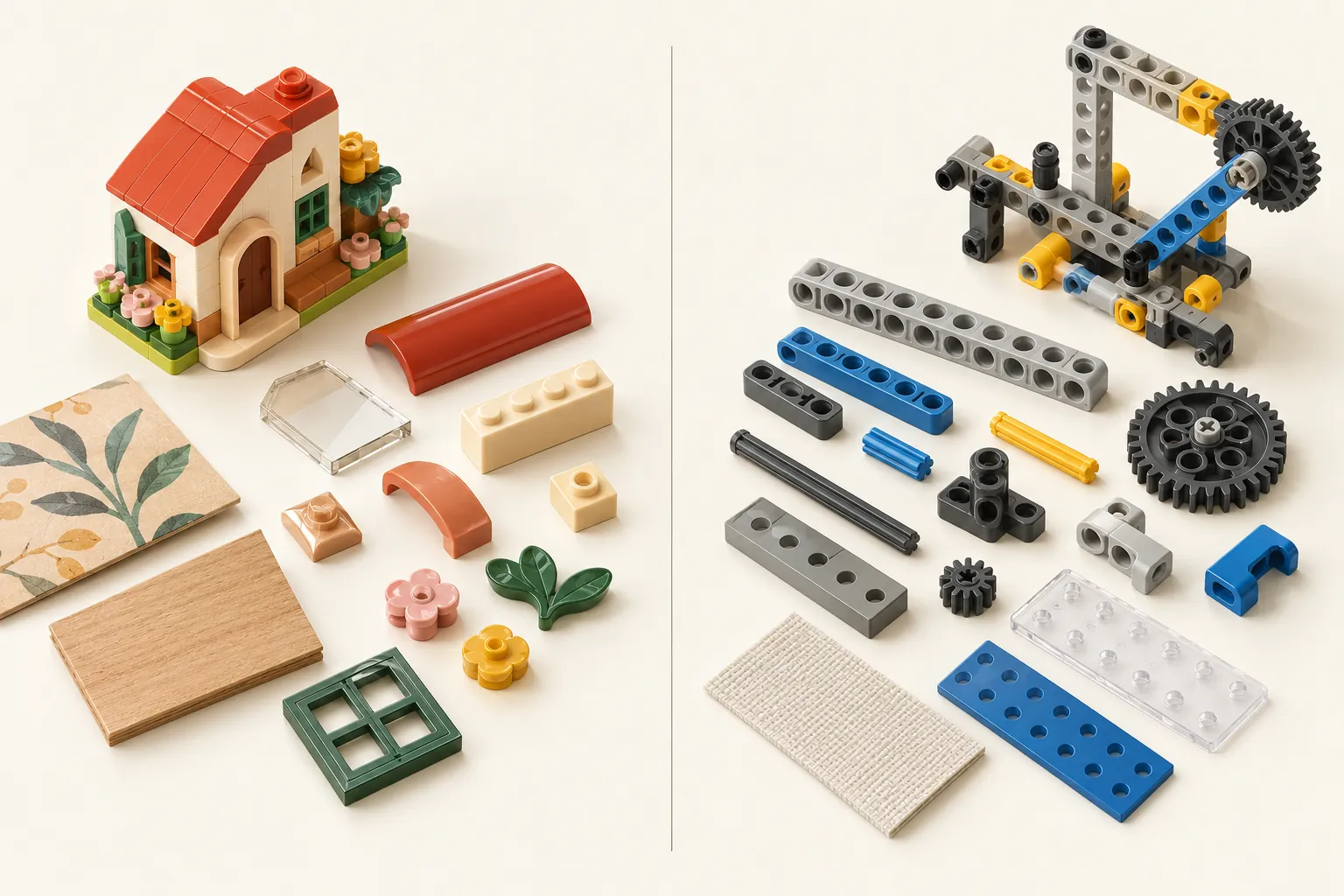
Which specifications separate a retail gift build from an education-channel kit?
Use the following comparison as a purchasing specification, not as a claim that every product in either channel has these features. Each row pairs a retail requirement with its education-channel counterpart and identifies what to request.
| Retail gift build — Construction mechanism: specify the connections and functions needed to complete the advertised model. Request close-up connection photos, a parts list, and a demonstration of any moving feature. | Education-channel kit — Construction mechanism: specify the connections needed for the intended activities, including disassembly and rebuilding where required. Request a demonstration using the proposed kit contents; do not assume cross-brand compatibility. |
|---|---|
| Retail gift build — Parts and model variants: define the contents of one saleable set and which advertised models those contents can produce. Request an illustrated inventory and clarification of alternative versus simultaneous builds. | Education-channel kit — Parts and activity variants: define the inventory per learner or working group and the parts each activity consumes. Request an activity-to-parts map so group-use requirements are explicit. |
| Retail gift build — Packing and sales unit: specify the complete customer-facing unit, internal bags or trays, and presentation artwork. Request a packed sample and a separate export-carton specification. | Education-channel kit — Packing and sales unit: define whether the purchase is an individual kit or a shared resource. Specify storage, sorting, and reset requirements where needed; request a packing diagram and a separate export-carton specification. |
| Retail gift build — Documentation: require instructions matching the included parts and advertised model options. Review the actual booklet or digital file alongside the packaging artwork. | Education-channel kit — Documentation: require build instructions plus the activity guidance needed for the proposed use. Request facilitator notes, reset instructions, or a group allocation sheet only where the intended program requires them. |
| Retail gift build — Order-quantity logic: quote in complete saleable sets and identify any assortment conditions. Request the current MOQ, units per carton, and any explicit order-multiple restriction as separate fields. | Education-channel kit — Order-quantity logic: define whether the quotation covers individual kits, group sets, or a larger activity pack. Request the current MOQ and packing quantities in that same unit; a piece count is not an order quantity. |
| Retail gift build — Reorder control: identify the approved parts list, model instructions, and packaging revision. Request a change declaration against the approved sample before repeat-order approval. | Education-channel kit — Reorder control: identify the approved parts inventory, activity files, and storage configuration. Review substitutions against existing activities and any replacement-parts arrangement. |
| Retail gift build — Sample review: assemble the advertised build using only the contents and instructions in the proposed sales unit. Record discrepancies against the agreed specification. | Education-channel kit — Sample review: run the intended activity, disassemble where required, sort the parts, and reset the kit. Record practical observations separately from safety-test evidence or claims about learning outcomes. |
How do two catalog candidates change the buying decision?
Treat the four-in-one car-and-truck build as a retail-gift candidate and the magnetic construction kit with marbles as an education-channel candidate, with final classification conditional on the sample and documentation review.
The October 9, 2026 catalog snapshot records different packing descriptions and reference minimums for these products. Those fields help frame a quotation request; they do not establish the complete user experience or prove a channel classification.
| Four-in-one car-and-truck construction set | Catalog record: named as a 1,152-piece, four-in-one build; packing recorded as Display Box; reference MOQ 20. Retail-gift decision: inspect the actual customer-facing unit rather than assuming “Display Box” means an individual gift box. Request the illustrated inventory and instructions, and confirm whether the four models are alternatives or can be built together. |
|---|---|
| Magnetic construction kit with marbles | Catalog record: described as magnetic construction with marbles; packing recorded as Kits; reference MOQ 2. Education-channel decision: specify the intended activity and learner/group allocation, then review the connection system, activity instructions, contents, and reset arrangement. The words “magnetic” and “kit” alone do not establish those operating details. |
| Decision before quotation approval | For a boxed model-building gift, advance the car-and-truck candidate to a packed-sample review. For a reusable marble-construction activity, advance the magnetic candidate against an explicit activity and reset specification. Do not select the education candidate merely because its recorded reference MOQ is lower; the quoted unit and required contents must match the buying task. |
What does a catalog record establish before approval?
A catalog record establishes the supplier’s recorded description, not independently verified performance, certification, age suitability, inventory, licensing, or factory capacity. Keep the current quotation, sample observations, and applicable product documentation distinct from the catalog entry.
For this decision, verify the connections directly. A magnetic system can be sold as a gift, and a conventional building system can support an organized activity. The mechanism determines what can be built; the contents, instructions, packing, and operating plan determine whether the proposed purchase fits the channel.
Keep quantity and dimensional fields equally disciplined. Pieces inside a set are not the MOQ. Units per carton are not automatically an order multiple. Product or parcel dimensions should not be entered as export-carton dimensions without confirmation.
Use sample assembly and reset checks as commercial acceptance checks. They do not establish safety compliance or demonstrate educational outcomes.
What should each candidate’s quotation or reorder record contain?
File one comparison record per candidate, with the intended channel, specified target, supporting evidence, observed result, and approval decision kept together. The record supports traceability; it does not itself detect an undisclosed substitution.
Use “supplier-declared” for a quotation or catalog statement, “observed” for a documented sample finding, and “awaiting confirmation” for an approval condition still to be closed. A single unresolved field need not invalidate other evidence: identify exactly which decision it affects.
| Identity and revision | Record the supplier’s product identifier, product name, quotation date/version, sample reference, parts-list revision, instruction revision, and packaging revision. Select the proposed classification: retail gift build, education-channel kit, or separately specified versions for both. |
|---|---|
| Specified target versus observation | Enter the required mechanism, contents, sales unit, documentation, and operating arrangement. Beside each target, record the supplier statement or dated sample observation, its evidence status, and the supporting file or photo reference. |
| Candidate-specific check — car-and-truck build | Retain the catalog description as supplier-declared. Record the observed customer-facing packing, counted contents against the agreed inventory, instruction revision, and whether the four model options use shared parts. Resolve any difference from the intended gift specification. |
| Candidate-specific check — magnetic marble kit | Retain the catalog description as supplier-declared. Record the demonstrated connection system, contents per purchased kit, activity instructions, and the observed sorting/reset process against the intended learner or group allocation. |
| Decision and approval | Record approved, conditionally approved, or held for the stated channel and revision. Name the responsible approver and approval date. State each condition precisely, including which quotation, sample, or reorder decision it restricts. |
| Follow-up closure | Assign an owner and due date to each open condition. Close it with the revised file or sample reference, reviewer, and closure date. For reorders, retain the change declaration and review any affected specification before release. |
Which final questions determine channel approval?
Can the same construction set serve both channels?
Yes, if it meets both specifications. Review the retail sales unit and instructions separately from the education activity, allocation, and reset requirements. If the contents or packing differ, identify the versions separately in the quotation and approval record.
What should I request first if the instructions are not yet available for review?
Request the illustrated parts inventory and the actual instruction file for the quoted version before approving the documentation-dependent classification. For education use, add the intended activity instructions. Those files let you assess whether the promised build or activity is supported by the included contents.
Does an education-channel kit always need shared storage?
No. An individually assigned activity kit may use its own packing. Specify shared storage and sorting only when the operating plan calls for pooled parts or repeated group use; the channel label alone does not determine the packing.
When should a changed reorder receive another sample review?
Request an updated sample when a change affects the connections, contents, build sequence, or packing functions being approved. Review artwork-only changes against the approved artwork and packing specification. Keep unaffected evidence, but do not carry an earlier observation over to a changed feature without checking it.