
A store-window buyer sets a motorized marble run on the display plinth at 9 a.m., switches it on, and walks away. By 9:40 the loop has jammed twice, the lift motor is warm, and the marbles are stacked behind the top of the spiral. The fix is not a bigger motor; it is choosing the lift mechanism, gear setting and jam-release path before the purchase order is signed.
This guide compares the two lift designs that dominate motorized marble run assortments: the spiral auger screw and the chain-step elevator. It covers gear load, jam release and battery compartment checks, and it treats the motorized marble run as a Marble Run Building Sets SKU with non-magnetic buildable tracks, not as a magnetic building toy.
U.S. Building Sets retail sales reached $4.3 billion in 2025, up 15% versus 2024 and up 57% versus 2021, inside a $30.3 billion total U.S. toy market, per Circana data published by The Toy Association. Games/Puzzles added $4.9 billion, up 37%, while Outdoor & Sports Toys slipped 6% to $4.0 billion. That category momentum funds sampling, but the sample still has to prove the lift across a 480-minute display day.
Why the lift mechanism decides the display, not the marble count
A 300-piece motorized marble run and a 120-piece motorized marble run can share the same lift motor, the same 1.5 V AA cell count and the same exit interval. Piece count is not order quantity, and it says nothing about how many marbles return to the top of the loop per minute. Buyers who shortlist by piece count end up comparing box weight instead of throughput.
Classify first by construction mechanism. Non-magnetic buildable tracks belong to Marble Run Building Sets; magnetic tracks belong to Magnetic Building Toys, and magnetic rods are not magnetic tiles. A motorized marble run with clip-together plastic track and a screw or chain lift sits in Marble Run Building Sets, and the listing should say so in the first product attribute line.
Then separate theme, age band and piece system as attributes. A dinosaur-themed motorized marble run and a space-themed one can share the same lift module; the theme changes packaging and shelf appeal, not the gear load. The lift module is the engineering unit that gets sampled, tested and reordered.
Spiral auger lifts: continuous flow and where torque runs out
The spiral auger is a continuous screw: the motor turns a helical flight, and marbles ride up the channel one after another. Flow looks smooth because the exit interval is short and regular. The engineering risk sits at the top of the spiral, where the marble must clear the last flight and roll onto the track with enough speed to enter the loop.
Teach Engineering's gear activities state that gears transmit power and can gain mechanical advantage to lift a heavy load or speed up a light-load process. The same activity set states that smaller gear ratios pick objects up quickly while larger gear ratios make it easier to lift heavy objects. An auger geared for fast exit intervals is a small-ratio build; add marbles and friction and the top of the spiral is where it stalls.
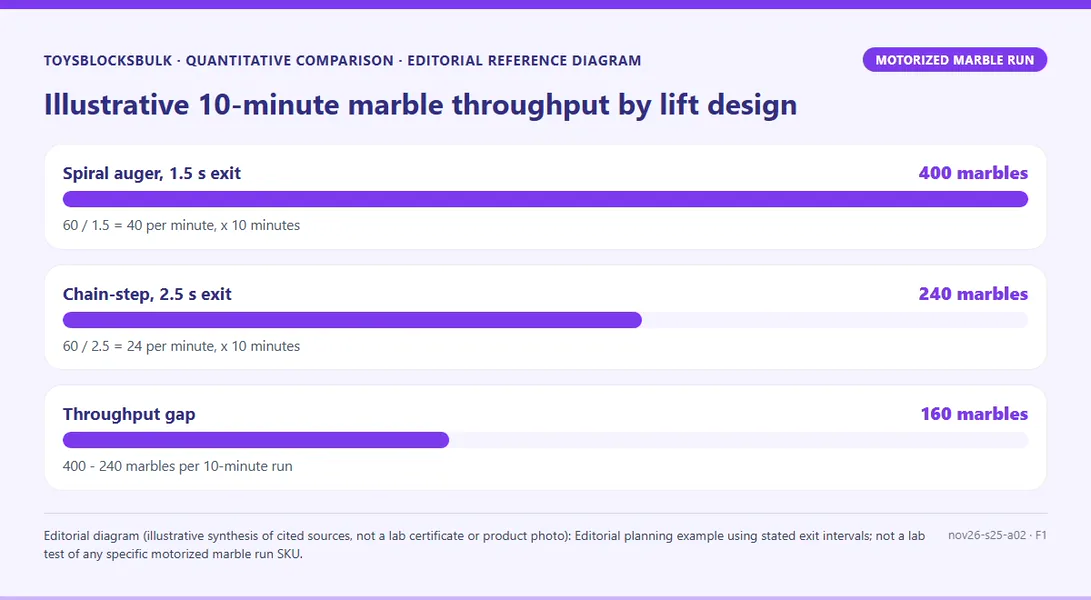
Illustrative planning example, not a lab test: suppose the sample auger exits one marble every 1.5 seconds at the intended gear setting. Then 60 / 1.5 = 40 marbles per minute, and 40 x 10 = 400 marbles across a 10-minute continuous display run. Check the arithmetic against the clock: 600 seconds / 1.5 seconds = 400 exits. Scale that to a 480-minute display day and 28,800 seconds / 1.5 = 19,200 marble exits. If the lift stalls at minute 6, the real figure is lower, and the sample has told you the gear setting is wrong for a full load.
Chain-step elevators: discrete steps and load tolerance
The chain-step elevator carries marbles in pockets or on step plates fixed to a chain. Each step takes one marble, so the exit interval is set by chain speed and step pitch, not by screw friction. Load spreads across several steps at once, which is why chain lifts tolerate a heavier marble load at the same motor.
The trade-off is visible speed. Teach Engineering's Get in Gear activity introduces torque as a twisting force and speed as the two traits of rotating engines, and its design challenges test the torque-versus-speed trade-off directly. A chain-step elevator geared for load runs slower in a window display; a chain-step elevator geared for speed drops marbles at the top step.
Illustrative planning example, not a lab test: suppose the chain-step sample exits one marble every 2.5 seconds at the intended gear setting. Then 60 / 2.5 = 24 marbles per minute, and 24 x 10 = 240 marbles across a 10-minute run. Against the auger example, 400 - 240 = 160 marbles fewer per 10-minute run. Over a 480-minute display day, 28,800 seconds / 2.5 = 11,520 marble exits, which is the throughput cost of the load-tolerant design at these settings.
Auger versus chain-step: sample checks that separate the two lifts
Run every row on the physical sample at the intended gear setting, with the intended marble count loaded, before quotation approval. Record the result against the SKU and variant, and keep the video with the approval file.
| Check | Spiral auger lift | Chain-step elevator | Evidence to request |
|---|---|---|---|
| Lift principle | Continuous helical screw channel | Discrete step pockets on a chain | Mechanism drawing plus 60-second sample video |
| Throughput measure | Exit interval per marble, e.g. 1.5 seconds | Exit interval per step, e.g. 2.5 seconds | Timed 10-minute run with a stopwatch log |
| Gear load | Torque-sensitive at the top of the spiral | Load spread across several steps | Gear-ratio note plus loaded lift test at full marble count |
| Jam release | Clear the screw channel at the jam point | Clear the step pocket and chain path | Tool-free clearing demonstration on video |
| Battery compartment | Cell count, contact retention, screw-fixed door | Cell count, contact retention, screw-fixed door | Photo of compartment, door fastening and cell orientation |
| Catalog category | Marble Run Building Sets, non-magnetic track | Marble Run Building Sets, non-magnetic track | Listing attribute sheet with mechanism, theme, age band and piece system |
Gear load: what to record and what to measure on a sample
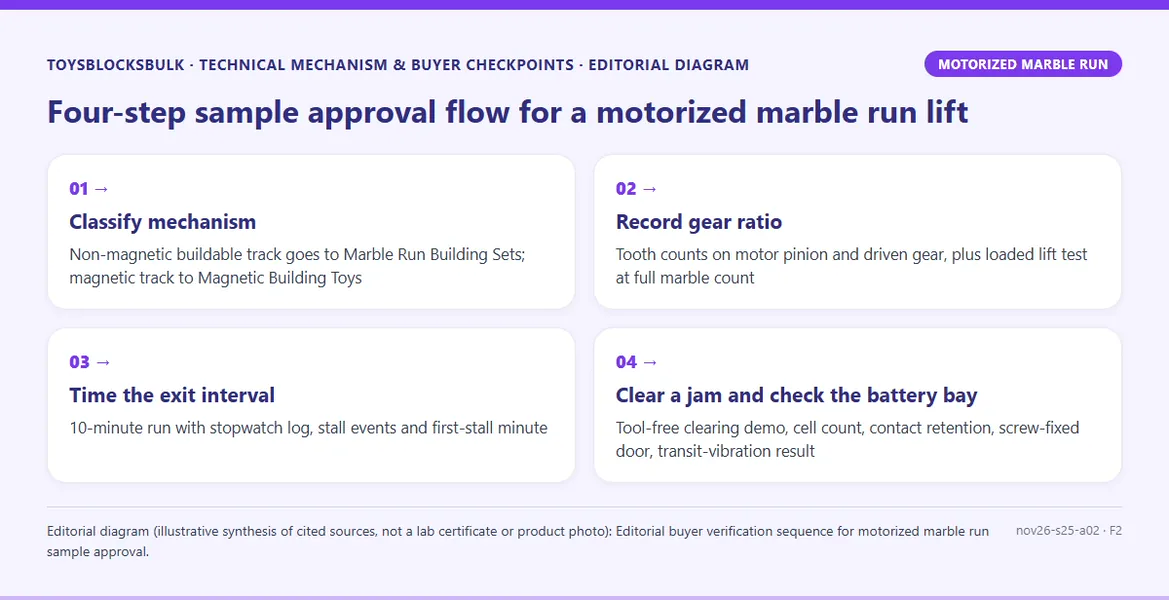
Request the gear-ratio note in writing: tooth counts on the motor pinion and the driven gear, plus the resulting ratio. Teach Engineering's Tug of War Battle Bots activity treats gear ratios, wheel size, weight and engine power as the variables teams change to alter pulling performance; the same four variables set whether a lift clears the top of the loop with a full marble load. Illustrative planning example, not a lab test: a 2.4:1 ratio means the motor pinion turns 2.4 times per 1 driven-gear turn, and a 4.8:1 ratio doubles that motor-side rotation per driven turn.
Then run a loaded lift test. Load the loop with the marble count stated on the pack, start the motor, and time the exit interval for 10 minutes. Record three numbers: exits per minute, stall events, and the minute at which the first stall occurs. A lift that stalls at minute 6 of a 10-minute run leaves 4 minutes / 10 minutes = 40% of the test window unverified, and it fails a window display that runs 8 hours.
Listen under load as well. A motor that changes pitch at the top of the spiral is working against friction in the channel; a motor that holds pitch and still stalls is under-geared for the load. Both results belong in the approval file with the gear-ratio note, because a reorder that swaps the motor or the gear set changes the lift performance without changing the SKU name.
Jam release: clearing the loop without tools or damage
Define the jam-release test before the sample arrives: block the loop with the stated marble count, let the motor run 10 seconds against the jam, switch off, and clear the obstruction by hand. The auger design passes when the screw channel can be cleared from the open side of the spiral without removing the lift module. The chain-step design passes when the step pocket and chain path can be cleared without splitting the loop frame.
Record motor behavior during the 10-second jam: audible strain, housing temperature rise, and whether the motor restarts cleanly after clearing. A lift that needs disassembly to clear a jam will come back as a retail return, and a lift that keeps driving against a jam transfers the load into the gear train. Illustrative planning example, not a lab test: an 8-hour window display equals 480 minutes, or 48 ten-minute test windows, so a lift that stalls once per 10-minute window records 48 stall events per display day.
Battery compartment and documentation checks before quotation
US consumer product safety authority lists potential battery hazards including overheating, fire, electrical shock from chargers, thermal burns, exposure to alkaline battery electrolytes, and high-velocity ejection of internal components, with incidents occurring in use, in storage and during charging. That list turns the battery compartment into a documented test item: cell count and size, contact retention under a pull test, screw-fixed door rather than a friction latch, correct cell orientation marks, and no loose cells after a transit-vibration check.
For U.S. buyers, US consumer product safety authority states that US children's product safety rules Section 106 made ASTM F963 a mandatory consumer product safety standard for children's toys, codified at 16 C.F.R. part 1250, and that third-party testing and CPC certification apply to toys intended primarily for children 12 or younger. Confirm the intended audience in writing and request item-specific test evidence and a CPC where the age band falls inside that scope. Supplier-declared certifications are not verified compliance, and a generic certificate does not substitute for the required documentation.
Settle the documentation set before quotation: listing attributes for mechanism, theme, age band and piece system; the sales unit and packout; the battery type and count; the instruction sheet language; and the test evidence tied to the exact SKU and variant. Piece count is not order quantity, and a master-carton dimension taken from a parcel listing is not a carton specification.
Is a motorized marble run a marble-run set or a magnetic building toy?
A motorized marble run with non-magnetic buildable tracks belongs to Marble Run Building Sets, while magnetic tracks belong to Magnetic Building Toys. Magnetic rods are not magnetic tiles, so keep the two listings separate and name the lift mechanism in the attribute sheet.
Theme, age band and piece system are separate attributes from the construction mechanism. A motorized marble run listing that mixes magnetic-track claims with a screw lift will fail a catalog audit on the first reorder.
Does a higher gear ratio make a motorized marble run lift faster?
No. Teach Engineering's gear activities state that smaller gear ratios pick objects up quickly while larger gear ratios make it easier to lift heavy objects, so a higher ratio trades speed for lifting ability. Measure the exit interval and the loaded lift on the sample at the intended gear setting before choosing the auger for a busy window display.
A 1.5-second auger exit interval yields 40 marbles per minute, while a 2.5-second chain-step interval yields 24 marbles per minute in the same illustrative arithmetic. The faster figure only holds if the lift does not stall at the top of the loop under the full marble load.
Can a supplier's certificate prove a motorized marble run is compliant?
No. Supplier-declared certifications are not verified compliance. For U.S. buyers, US consumer product safety authority states that ASTM F963 is mandatory for children's toys under 16 C.F.R. part 1250, with third-party testing and CPC certification for toys intended primarily for children 12 or younger, so request item-specific evidence tied to the exact SKU rather than a generic certificate.
Pair the test evidence with the battery compartment record: cell count, contact retention, screw-fixed door and transit-vibration result. US consumer product safety authority's battery hazard list covers incidents in use, in storage and during charging, which is why the compartment check is a documented test item and not a glance at the mold.
Shortlist the lift, then approve the SKU
Send the lift mechanism, gear-ratio note, exit interval, marble load, battery cell count and jam-release result for each motorized marble run variant under review. ToysBlocksBulk compares variants by construction system, confirms the sales unit and packout, and settles documentation and delivery terms before quotation approval.
Keep magnetic-track SKUs in Magnetic Building Toys and non-magnetic buildable tracks in Marble Run Building Sets, and attach the sample video to the approval record so a reorder version change is visible before the carton ships.