
A buyer opens a sample carton of a magnetic marble run and finds two different joint systems in the same box: flat magnetic tiles with snap-in track clips, and a bag of round tubes with collars. The two systems look interchangeable on the shelf photo and behave nothing alike once a 12 in column carries a 3-tile span. The first approval decision is not color, theme or piece count; it is which connection mechanism the SKU actually uses, because that mechanism sets the failure mode you will see at retail and the evidence you must hold before quotation approval.
Snap-in track clips belong to the magnetic-building side of the catalog: a clip grips the tile edge and a magnet pair holds the joint closed. Tube-and-collar marble runs belong to the marble-run-blocks side: one tube end seats into a collar or socket and friction plus geometry holds the run. ToysBlocksBulk classifies magnetic tracks under Magnetic Building Toys and non-magnetic buildable tracks under Marble Run Building Sets, and that split should appear in the SKU title, the sales-unit description and the sample file before any price discussion.
This comparison walks the structural differences that matter to importers, distributors and private-label buyers: setup and rebuild behavior, how a vertical column transfers load through each joint, ball diameter against the US consumer product safety authority small-parts cylinder, and the magnet-rule route that decides which test report and certificate citation the approval file must contain.
Which connection mechanism should the sample prove first?
The snap-in clip is a two-part joint: a molded clip that mechanically captures the tile edge plus a magnet pair that keeps the clip seated. The failure mode is clip retention, meaning the clip either releases from the tile edge or slides along it when a lateral force is applied. The tube-and-collar joint is a single-part interference fit: the tube end enters the collar and the collar wall resists pull-out and rotation. Its failure mode is collar split or tube pull-out at the socket mouth.
Approval evidence differs by mechanism. For a clip-on magnetic tile track, the sample file should record clip pull-off force direction (perpendicular to the tile face and parallel to it), the number of clip-and-release cycles the clip survived before visible deformation, and whether the magnet pair is captive inside the clip or accessible when the clip is removed. For a tube-and-collar run, the file should record tube insertion depth in millimeters, collar wall thickness, and the pull-out result at the socket mouth after 20 assemble-disassemble cycles.
Both mechanisms carry a small-parts question, because a clip, a collar or a marble can each fit the small parts cylinder at 16 CFR 1501.4. A small part is any object that fits, without compressing and in any orientation, entirely into that cylinder, and children's products for use under 3 that present a choking, aspiration or ingestion hazard because of small parts are banned hazardous substances under 16 CFR part 1501. The sample file should therefore list every separable component with its measured dimensions, not only the marble.
The catalog split follows the mechanism, not the theme. A dinosaur-themed magnetic marble run with snap-in clips is a Magnetic Building Toys SKU; a space-themed tube-and-collar run is a Marble Run Building Sets SKU. Theme, age band and piece system are separate attributes, and piece count is not order quantity.
Setup speed and rebuild behavior: what the built sample should show
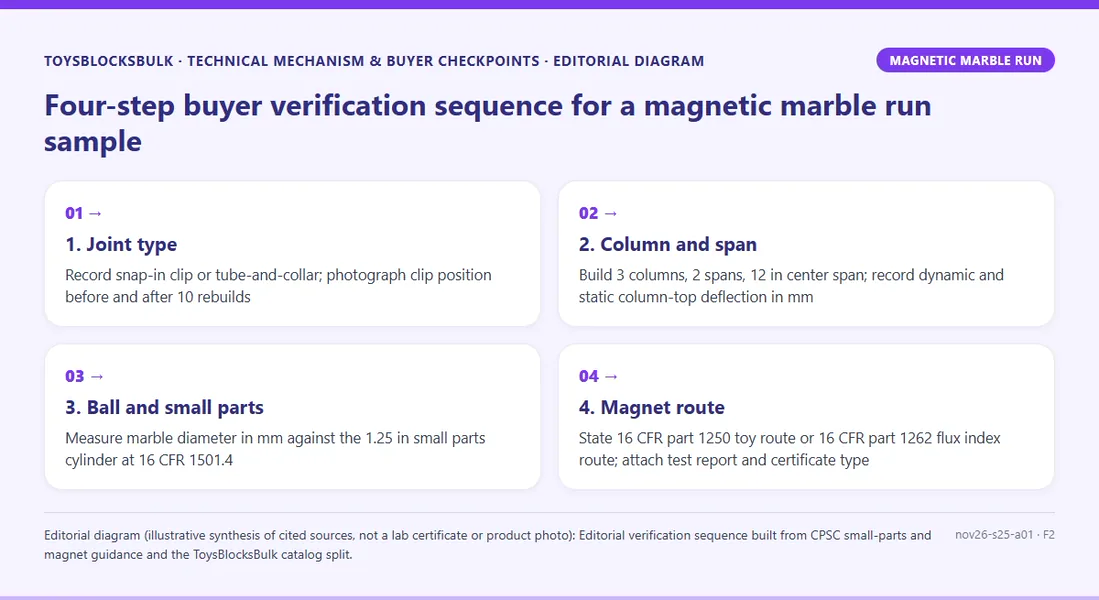
A clip-on magnetic tile track assembles in two motions per joint: seat the clip on the tile edge, then bring the mating tile or track segment into magnetic contact. Rebuild tolerance is high because the magnet pair re-centers the joint, but the clip can migrate along the tile edge between builds, so the sample should be rebuilt 10 times and the clip position photographed before and after. A tube-and-collar run assembles in one motion per joint but demands alignment: a tube inserted at an angle loads the collar wall unevenly, and repeated rebuilds at the same socket show whether the collar deforms.
Run the rebuild count as arithmetic, not as an impression: 10 rebuild cycles on a 6-span configuration equals 60 joint assemblies and 60 joint disassemblies, so each clip or collar is inspected 60 times per sample. That is an illustrative planning figure for the sample bench, not a durability rating for any SKU.
The merchandising rationale for a buildable marble run sits at category level. lists length, measurement, comparison, number, estimation, symmetry and balance among the math concepts and skills practiced through block play, and notes that stacking objects helps children understand movement and space through sensory-motor skills and spatial understanding. Neither source tests a magnetic marble run, clip retention or column load, so the packaging copy should stay at category level until item-specific evidence exists.
Setup speed is a sales-unit claim only when it is measured. Record the assembly time for a 3-column, 6-span configuration in seconds on the sample bench, and record the same figure for the tube-and-collar comparator. A 6-span build at 2 joints per span equals 12 joints, and a 20-second difference per joint equals 240 seconds (4 minutes) of total assembly-time difference between two mechanisms. That 4-minute gap on a 12-joint build is a defensible instruction-quality note; an unmeasured 'fast setup' line is not.
Span support and vertical columns: why 'sturdy' is not a specification
In a clip-on magnetic tile track, the vertical column carries load through tile faces in compression, and the clip joints transfer lateral marble momentum into the tile plane. The critical measurement is unsupported span between two columns at the height where the marble changes direction, because that is where the joint sees the highest bending moment. In a tube-and-collar frame, the column carries load through the tube wall in compression and the collars act as moment connections; the critical measurement is the same unsupported span, but the joint stiffness depends on insertion depth rather than magnet strength.
The built-sample protocol is identical for both mechanisms: build a 3-column, 2-span configuration with a 12 in center span, run 20 marbles through it, and record column-top lateral deflection in millimeters before and after the run. Add a 0.5 lb static side load at the top of the center column and record deflection again. Those three numbers (span, dynamic deflection, static deflection) belong in the approval file, and they replace the word 'sturdy' in every internal document.
Keep the span arithmetic explicit: a 3-column, 2-span frame with a 12 in center span gives 24 in of total supported run length, and a 0.5 lb static side load at the center column top equals 8 oz of side load at that joint. Both figures are illustrative planning inputs for the bench protocol, not test results.
Column height interacts with ball speed. A 24 in column gives 12 in more vertical drop than a 12 in column, so the same marble reaches the bottom turn with more momentum at the taller column and stresses the same clip joint differently. Record the tested column height with the deflection figures; a deflection result without a stated height cannot be compared across SKUs or reorders. A 3 mm dynamic column-top deflection and a 5 mm static deflection under the 0.5 lb side load give a static-to-dynamic ratio of 1.67, which is a bench comparison figure, not a pass/fail limit.
Snap-in clip magnetic tile track vs tube-and-collar marble run
The table separates the two mechanisms on the fields a buyer records at sample approval. Cells carry sourced rule citations or explicit measurement instructions; no cell asserts a stability or age-suitability result for a specific SKU.
| Attribute | Approval field to record | Tube-and-collar marble run | Snap-in clip magnetic tile track |
|---|---|---|---|
| Connection mechanism | Joint type code on SKU sheet | Tube end seats into collar or socket; friction and geometry hold | Molded clip captures tile edge plus magnet pair holds joint |
| Catalog category | Category tag in product title and sales unit | Marble Run Building Sets | Magnetic Building Toys |
| Primary failure mode | Cycles to visible deformation at 20 assemble-disassemble cycles | Collar split or tube pull-out at socket mouth | Clip release or slide along tile edge |
| Load path through vertical column | Unsupported span in inches at direction-change height | Tube wall in compression; collars act as moment connections | Tile faces in compression; clip joints transfer lateral momentum |
| Small-parts and ball check | Measured diameter per component; 16 CFR part 1501 citation on CPC | Marble and collar measured against 1.25 in cylinder diameter | Marble, clip and magnet housing measured against 1.25 in cylinder diameter |
| Magnet-rule exposure | Test route statement and flux index result if 16 CFR part 1262 applies | No magnet content unless clips or connectors include magnets | Route depends on whether item is a toy under 16 CFR part 1250 (ASTM F963) |
Ball sizing and age positioning under U.S. rules
Ball diameter decides which age band a marble run can be positioned for, and the test is the US consumer product safety authority small parts cylinder at 16 CFR 1501.4. Here is an illustrative planning calculation, not a lab test: the cylinder measures 1.25 in diameter by 2.25 in depth. A 0.63 in (16 mm) marble is less than 1.25 in, so it fits the cylinder diameter and counts as a small part. A 0.98 in (25 mm) marble is also less than 1.25 in, so it also fits and also counts as a small part. The deciding number is the 1.25 in cylinder diameter, not the difference between the two balls.
The consequence is direct: a marble run whose ball fits the cylinder cannot be positioned as an under-3 item on ball size alone, because children's products for use under 3 that present a choking, aspiration or ingestion hazard because of small parts are banned hazardous substances under 16 CFR part 1501. For the age band you do choose, the packaging and advertising must carry the choking-hazard warning required by 16 CFR 1500.19, and advertising for toys subject to that labeling must use the same warning under 16 CFR 1500.20.
The CPC citation for the small parts ban is '16 CFR part 1501 – Small parts'. The choking-hazard warning label requirement itself is not entered in the CPC, so the approval file should hold the label artwork separately from the certificate citation. Record the measured marble diameter in millimeters, the cylinder comparison result, the chosen age band and the exact warning text at sample approval.
Magnet compliance route: which document the approval file must hold
The US consumer product safety authority magnet standard at 16 CFR part 1262 applies to subject magnet products manufactured after October 21, 2022, and requires every loose or separable magnet that fits entirely within the small parts cylinder to have a flux index below 50 kG2 mm2. Toys subject to 16 CFR part 1250, which incorporates ASTM F963 by reference, are exempt from the magnet standard. A magnetic marble run therefore sits on one of two routes, and the approval file must state which route applies rather than accepting a generic 'magnet tested' line.
If the item is a toy under 16 CFR part 1250, the file should cite the ASTM F963 route and hold the applicable test report. If the item is treated as a subject magnet product under 16 CFR part 1262, the file should hold the flux index result for every loose or separable magnet that fits the cylinder, tested under sections 8.25.1 through 8.25.3 of ASTM F963. Certification follows Section 14(a) of the Consumer Product Safety Act: a CPC for children's products, a GCC for general-use products.
The route statement is a one-page document in the approval file: item classification, manufacture date after October 21, 2022, the cited rule, the test report number and the certificate type. On reorder, the same page is re-signed against the new production date, because the magnet rule keys to manufacture date rather than to SKU launch.
The reorder file that re-verifies clip retention, column stability and ball sizing
Build the approval file as eight fields so a reorder can be checked without rebuilding the whole sample program: measured marble diameter in millimeters; measured clip or collar dimensions against the 1.25 in cylinder diameter; joint type code; tested column height in inches; unsupported center span in inches; dynamic and static column-top deflection in millimeters; exact choking-hazard warning text under 16 CFR 1500.19; and the magnet-rule route statement with test report number and certificate type. Photograph the clip position before and after 10 rebuilds and attach the images to the joint-type field.
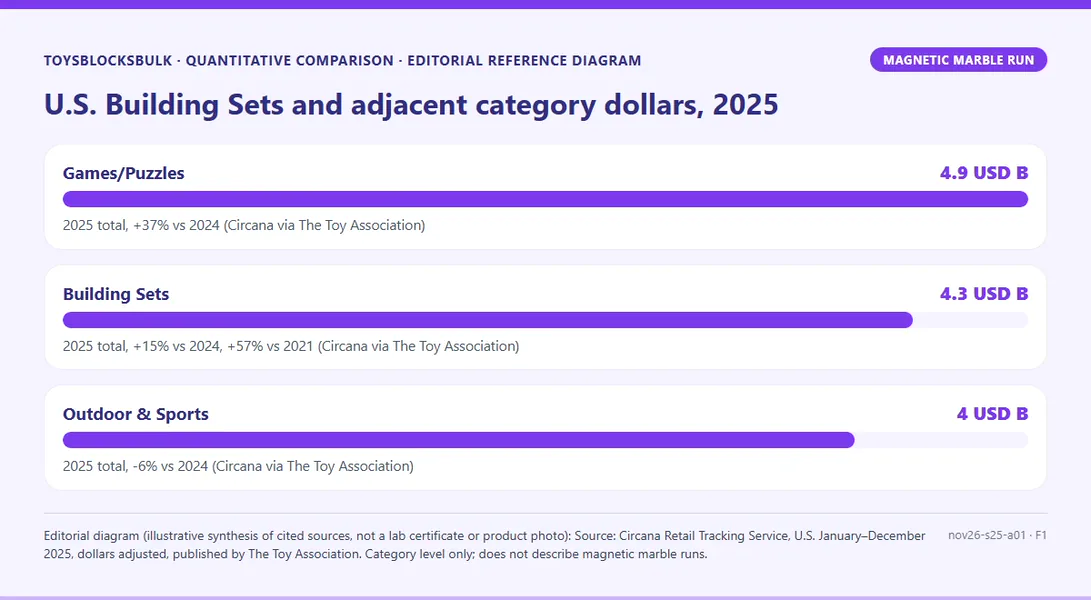
Category context belongs in the range plan, not in the approval file. U.S. Building Sets retail sales reached $4.3 billion in 2025, up 15% vs 2024 and up 57% vs 2021, per data published by The Toy Association. The same 2025 table lists Games/Puzzles at $4.9 billion (+37% vs 2024) and Outdoor & Sports Toys at $4.0 billion (-6% vs 2024), so building sits between a fast-growing games block and a shrinking outdoor block. The table also lists Infant/Toddler/Preschool Toys at $3.3 billion (-3% vs 2024) and Dolls at $2.5 billion (-7% vs 2024), which is the preschool shelf a marble run competes with for space. also reported U.S. toy dollar sales up 20% and units up 18% for January through September 2026, with Building Sets at +17% driven by the LEGO Botanical Collection. That 2026 growth note attributes momentum to a specific licensed line, so it supports shortlisting a marble run variant as range context and does not predict any single magnetic marble run SKU.
Are magnetic marble runs subject to the US consumer product safety authority magnet rule or exempt as toys?
A magnetic marble run is exempt from the 16 CFR part 1262 magnet standard when it is a toy subject to 16 CFR part 1250, which incorporates ASTM F963 by reference. If the item is not on that toy route, it is a subject magnet product and every loose or separable magnet that fits the small parts cylinder must show a flux index below 50 kG2 mm2 under 16 CFR part 1262, for product manufactured after October 21, 2022. The approval file states the route, the test report number and the certificate type.
Magnet testing on the 16 CFR part 1262 route follows sections 8.25.1 through 8.25.3 of ASTM F963. Certification runs through Section 14(a) of the Consumer Product Safety Act: a CPC for children's products, a GCC for general-use products.
What ball size can a marble run be positioned for under U.S. rules?
No marble diameter creates an under-3 position when the ball fits the small parts cylinder at 16 CFR 1501.4, and both a 0.63 in (16 mm) and a 0.98 in (25 mm) marble fit inside the 1.25 in cylinder diameter. Children's products for use under 3 that present a choking, aspiration or ingestion hazard because of small parts are banned hazardous substances under 16 CFR part 1501. For the age band you select, the packaging and advertising carry the 16 CFR 1500.19 choking-hazard warning, and the CPC cites '16 CFR part 1501 – Small parts'.
Record the measured ball diameter in millimeters and the cylinder comparison result at sample approval, and keep the warning artwork separate from the CPC citation because the warning requirement is not entered in the CPC.
How should a buyer classify a magnetic track marble run versus a classic tube-and-collar marble run in the catalog?
Classify by connection mechanism: a magnetic track marble run with snap-in clips goes under Magnetic Building Toys, and a non-magnetic tube-and-collar marble run goes under Marble Run Building Sets. ToysBlocksBulk applies that split because the two mechanisms produce different failure modes and different approval evidence, and the split belongs in the SKU title, the sales-unit description and the sample file.
Theme, age band and piece system are separate attributes, and piece count is not order quantity. A dinosaur theme on a clip-on magnetic track does not move the SKU into the marble-run category, and a space theme on a tube-and-collar frame does not move it into magnetic-building.
Put the mechanism on the SKU sheet before the price sheet
Shortlist magnetic marble run variants by joint type first: snap-in clip magnetic tile track or tube-and-collar frame. Then attach the eight-field approval file, the measured ball diameter against the 1.25 in small-parts cylinder, the column height and span figures, the 16 CFR 1500.19 warning text and the magnet-rule route statement. Agree selling unit, packaging, documentation and delivery terms only after those fields are complete.
Send the joint-type code and the measured sample figures with the quotation request so the comparison runs on structure rather than on shelf photography.