
If you import magnetic rods and balls wholesale, the practical answer is this: treat every inbound lot as a traceability record keyed to the recall identity of the product you actually received, not to the category it belongs to. The US consumer product safety authority recalled Huaker Magnetic Balls and Rods Sets on February 19, 2026 under recall number 26-272 because the sets contain small balls and are intended for children under three, which the agency says violates the mandatory toy standard and poses a deadly choking hazard US consumer product safety authority recall 26-272. That notice names one product. It does not name ours, and it does not create a recall for any SKU on this site.
What it does do is give you a receiving template. The recalled sets were sold on Amazon.com from September 2025 through November 2025 for about $23, came as 88 pieces in a handled plastic box marked "Magnetic Sticks" and "Model:20A-13", and carried no identifying marks on the magnetic toys themselves. That last detail is the one worth copying into your own intake process: if the pieces carry no marks, the carton and the lot record are your only identification. Build the record first.

What the Huaker Recall Actually Establishes — and What It Does Not
The notice establishes a dated US hazard for one named product: Huaker Magnetic Balls and Rods Sets, recall 26-272, dated 2026-02-19. The published hazard is specific — small balls plus an intended audience under three years of age. The remedy was a full refund, with consumers asked to stop use, keep the sets away from children, dispose of the product and email a photo of the disposed product.
It does not establish anything about ToysBlocksBulk SKUs, our suppliers, or any current recall status. Public recalls apply to the named models only. If you find a Huaker carton in a mixed container, that is a supplier and lot question, not a category question. If you find our cartons, the notice is a prompt to check your own records — nothing more.
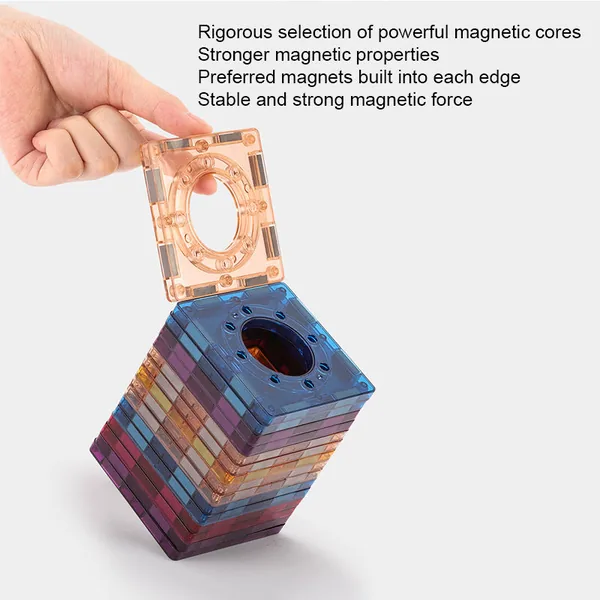
One more distinction that matters at receiving: the hazard follows the component, not the shelf label. A magnetic rod set with loose small balls is not the same risk object as a non-magnetic brick set, a magnetic tile set, or an LED-equipped brick set. Transfer only the hazard for the component actually present in the box.
How to Classify Bulk Building Sets by Connection Mechanism
Classify by how the parts connect, because that is what determines which hazard and which test evidence you need. Magnetic rods and balls, magnetic cubes and tiles, non-magnetic bricks, marble-run tracks and large building blocks are five different purchasing conversations even when they share a theme or an age band.
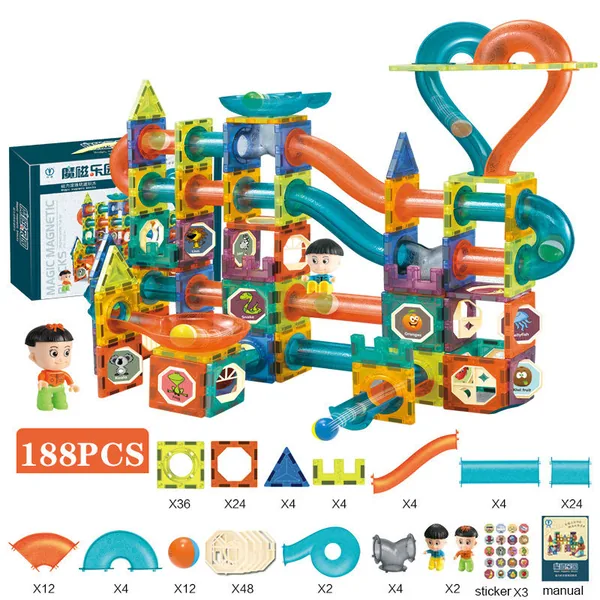
Magnetic tracks belong with magnetic building toys; non-magnetic buildable tracks belong with marble-run sets. Theme, age and piece system are separate attributes you record alongside the mechanism, not substitutes for it. This matters commercially: a buyer comparing a 188-piece magnetic marble-run track against a 1,152-piece brick car set is comparing two different risk profiles, two different instruction burdens and two different packaging costs.
Two catalog records illustrate how differently the same category can be configured. TBS-261048 is a plastic 2-in-1 pull-back racing car building block set in a color box, with a reference MOQ of 20 and 36 units per carton. TBS-289004 is a large educational STEM construction block set in ABS, color box, reference MOQ 80, 16 units per carton. Same broad shelf, very different order economics. Neither record is a certification, a stock statement or a capacity commitment.
Catalog Records Compared on the Same Commercial Unit
| TBS-261048 — product | Plastic 2-in-1 pull-back racing car building block set, red F1-style model |
|---|---|
| TBS-261048 — recorded material / packing | Plastic; color box |
| TBS-261048 — reference MOQ | 20 |
| TBS-261048 — units per carton | 36 |
| TBS-289004 — product | Large educational STEM construction block set |
| TBS-289004 — recorded material / packing | ABS; color box |
| TBS-289004 — reference MOQ | 80 |
| TBS-289004 — units per carton | 16 |
| TBS-243968 — product | Educational magnetic building blocks, 188-piece marble-run track, 3D plastic pipe magnetic bricks |
| TBS-243968 — recorded material / packing | Plastic; color box |
| TBS-243968 — reference MOQ | 1 |
| TBS-243968 — units per carton | 8 |
| TBS-257800 — product | Magic 1,152-piece 4-in-1 creative construction model car and truck set |
| TBS-257800 — recorded material / packing | Plastic; display box |
| TBS-257800 — reference MOQ | 20 |
| TBS-257800 — units per carton | 128 |
| Applies to | The exact SKU and configuration quoted; not transferable to other SKUs, colors or custom versions |
Reading MOQ, Carton Quantity and Piece Count Without Mixing Them Up
Three numbers get conflated constantly at quotation stage, and each one answers a different question. Piece count describes what is inside one retail set. Units per carton describes how the factory packs finished sets for shipment. Reference MOQ describes the smallest order the supplier is willing to quote for that exact product.
Do not derive one from another. A 188-piece set does not imply a low MOQ, and a reference MOQ of 1 does not mean the supplier will ship a single unit at a workable landed cost. Carton quantity is not automatically an order multiple either — unless the supplier explicitly restricts orders to full cartons, you are not obliged to round every order up to a carton multiple. Ask, in writing, which of the three governs your order.
Customization adds its own layer and its own MOQ. A base reference MOQ for a stock color box tells you nothing about the minimum for a custom-printed box, a custom colorway or a logo application. Those are separate quote lines with separate minimums, and they should be quoted separately rather than blended into one number.
The Inbound Lot Record: What to Capture at Receiving
A receiving record that survives a recall query has six fields, and none of them is optional. Capture them at container unload, not at month-end.
Supplier legal entity and factory name as printed on the commercial invoice. Purchase order number and the supplier's production or batch reference. Exact SKU and configuration received, including color and packaging variant. Quantity by carton and by unit, with the carton count reconciled against the packing list. Date of receipt and the container or shipment identifier. And the physical markings on the retail box — model number, brand text, any printed certification marks — photographed at carton level before the goods go to storage.
The Huaker notice is instructive here precisely because the magnetic toys themselves carried no identifying marks. When the product cannot identify itself, your carton photos and lot record are the identification. Store them where a warehouse supervisor can retrieve them in minutes, not where they sit in a buyer's email archive.
How to Segregate Stock If an Applicable Notice Ever Arrives
Segregation is a sequence, and the order matters. First, confirm the notice identity against your record: the exact product name, the recall number, the date and the responsible party. A notice that names a different model, a different brand or a different component is not your notice.
Second, check whether the received lot actually contains the component named in the hazard. For a small-ball hazard, that means verifying whether loose small balls are present in the sets you hold, and what age the product is intended for. If the component is absent, the hazard described does not transfer — but the check still belongs in your file.
Third, quarantine the matched lot physically and in the system: move it to a locked or clearly marked location, freeze it in inventory so it cannot be picked, and record who authorized the hold and when. Fourth, notify your downstream accounts that received units from that lot, using the lot record rather than a general product name. Fifth, keep the disposition decision — return, destroy, credit — documented with the supplier, because a refund remedy in a public notice describes the consumer path, not your commercial remedy.
What you should not do is quarantine an entire category. A recall of one magnetic rod set is not a reason to freeze every construction toy in the warehouse, and treating it that way costs you sellable inventory and warehouse time.
Approval Evidence: What to Ask For and What It Proves
Supplier-declared certifications are declarations, not verified compliance. That distinction should shape how you file them. A certificate image in a chat thread tells you the supplier believes a test exists; it does not tell you which SKU, which configuration, which test laboratory or which production batch it covers.
Ask for the test report itself, and read the scope line. Check that the model or item reference matches the SKU you are buying, that the configuration tested matches the configuration shipping, and that the applicable standard and edition are named. Where a report covers a tested construction, coverage follows that construction and the rules applicable at the time — it is not a blanket pass for every color, every packaging change or every future batch.
For construction toys aimed at the US market, the relevant question is whether the product falls under the mandatory toy standard and whether the small-ball or small-parts provisions apply given the intended age. For the EU, the applicable toy safety framework and its harmonised standards govern. Keep the age grading decision deliberate and documented: a set that a buyer markets for under-three use sits in a materially stricter position than the same parts sold for older children, and the recall record shows how seriously regulators treat that line.
Practical buyer criteria worth writing into your purchase order: report scope matching the ordered SKU, named standard and edition, laboratory identification, report date, and a supplier statement of which production batches the report covers. These are commercial checks. They are not a substitute for your own testing decision or for destination-market legal review.
What to Confirm in Writing Before You Commit
Before a purchase order goes out on any magnetic rods and balls wholesale program, get five things in writing: the exact SKU and configuration quoted, the sales unit and whether the order must be a full carton multiple, the base MOQ and the separate customization MOQ for your requested color, logo or packaging, the current price validity window, and the age grading the supplier intends the product to carry.
Then confirm the sample path. A physical sample lets you check the connection mechanism, the piece inventory against the stated count, the instruction quality and the packaging markings — the same attributes that made the Huaker notice traceable or untraceable. If the sample's box carries no model number, ask why before you order a container, not after.
Finally, ask directly about stock and reorder conditions. A color listed in a catalog does not establish that the color is in stock or that it ships immediately. Availability, reorder minimums and lead time are per-SKU answers that change, so they belong in a dated written confirmation attached to your PO.
Buyer Questions on Magnetic Rods and Balls Wholesale
Does the Huaker recall apply to magnetic building sets I buy from other suppliers?
No. Recall 26-272 names Huaker Magnetic Balls and Rods Sets only. It does not establish a recall, defect or non-compliance for any other product. The transferable value is the review question: does the set you are buying contain small balls, and what age is it intended for?
Is a magnetic rod set the same risk object as a magnetic tile or brick set?
They are different constructions and should be treated separately. Rods, balls, tiles and non-magnetic bricks differ in components, connection method and typical age grading. Apply the hazard only to the component actually present in the product you received.
Can I use the reference MOQ as my order quantity?
The reference MOQ is the smallest quantity the supplier will quote for that exact product and configuration. It is not an order multiple, and it does not cover custom colors, logos or packaging, which carry their own minimums and should be quoted separately.
How long should I keep inbound lot records?
There is no single rule that fits every market. Set a retention period long enough to cover the product's realistic selling life plus the enforcement window in your destination markets, and keep carton-level photographs with the lot record so a specific shipment can be identified without opening every box.
What if my supplier's certificate does not name my SKU?
Treat it as a declaration covering something else until the scope is clarified. Ask for the report with the model reference, tested configuration, standard and edition, and laboratory identified. If the scope cannot be matched to your SKU, that is a gap to resolve before ordering, not after.