
A catalog photo is a marketing asset, not evidence. The single most useful rule for vetting a building blocks wholesale supplier is to sort every claim into three buckets — observed evidence, supplier statements, and open questions — and then refuse to let a statement migrate into the evidence bucket until you have a document or a physical object in hand. Observed evidence is a sealed golden sample, a test report whose product configuration matches your SKU, a CPC containing all seven required elements, a business licence whose scope covers toy manufacturing. A supplier statement is a factory-area figure on a 1688 store page, a booth sample at a trade fair, a sentence in a quotation that says "we support OEM". An open question is everything you have not yet confirmed in writing: carton dimensions, the actual production factory address, whether a certificate covers this SKU or a sibling, and how exemptions are documented. Run the same three-bucket sort against every candidate and the comparison becomes mechanical instead of persuasive.
Key Takeaways
- A supplier's online performance metrics — on-time rate, response rate, return rate — are dated historical statistics, not guarantees for your order. Ask for the observation date or treat them as statements, not evidence.
- A Children's Product Certificate is a certification of compliance based on third-party test results, and it only works if you can match it to your exact SKU. The US consumer product safety authority lists seven required elements; a certificate missing any one of them is an open question, not proof.
- A sealed golden sample on the QC shelf settles colour, fit, flash and function disputes that email threads never will. Buyers who approve only a photo tend to pay for it on the second production lot.
- Region tells you what a cluster is good at, not whether a specific factory is competent. Chenghai runs in-house injection moulding and assembly with wholesale orders from one piece; Yiwu is distribution-heavy with cheap spare parts; Dongguan leans to precision OEM/ODM with higher mould quotes and MOQs.
- Incoterms without a version and a named place — for example FOB Shantou or FOB Shenzhen as actually booked — is not a commercial term. It is a future freight argument.
What is the difference between observed evidence and a supplier statement?
Observed evidence is anything you can inspect without trusting the supplier's description: a physical sample you hold, a test report with a report number and laboratory name, a certificate whose product identification matches your SKU, a business licence checked on the National Enterprise Credit Information Publicity System in China. Supplier statements are claims about capacity, MOQ, lead time, certification status and future performance. They may be true. They are still statements until a document backs them.
The practical test is simple. If the supplier disappears tomorrow, can you still prove the claim? A sealed golden sample in your office proves colour and fit. A quotation sentence saying "we are 3C certified" proves nothing about which SKU the certificate covers or whether it is still valid. A 3C certificate has a validity period and a covered product scope; the certificate number can be checked on the national certification and accreditation public service platform rather than trusted from a catalog image.
Open questions deserve their own column in your comparison sheet, not a mental note. Carton dimensions, inner-pack quantity, instruction-sheet language, whether the mould tool number printed on the sample matches the tool that will run your order — these are normal gaps at the quotation stage. Writing them down is what stops them becoming disputes after deposit.
Why does a trade-fair or catalog sample fail as a production standard?
A booth sample is often a hero unit, hand-picked and sometimes hand-finished. Fair lighting flatters colour; a photo taken under it will not match the bulk lot. The revision card does. Ask for the tool number and revision label to travel with the sample, and refuse to treat a Fair photo as the production standard.
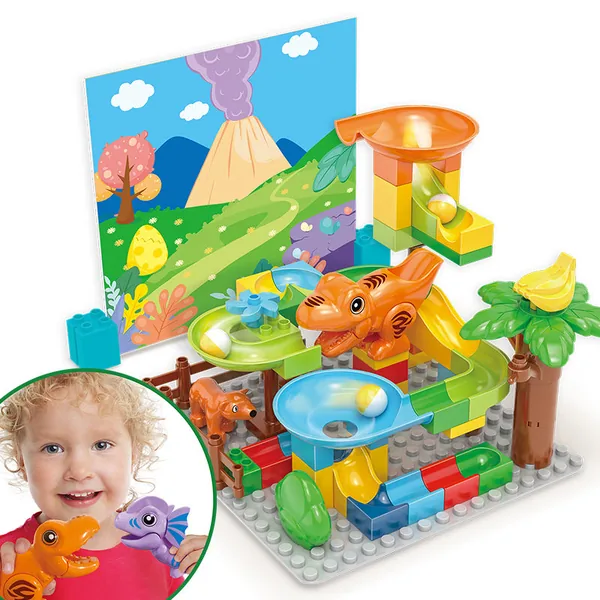
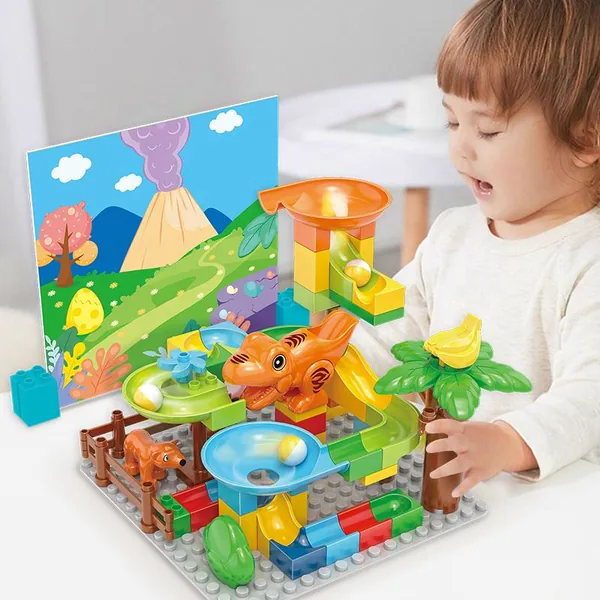
The same logic applies to online listings. Piece count on a product title is not a MOQ, and parcel dimensions are not carton data. A 60-piece marble-run set and a 1152-piece 4-in-1 car set can carry the same catalog polish and completely different packing economics. Until you have carton dimensions, inner-pack quantity and gross weight, you cannot quote freight honestly, and any landed-cost comparison you build is provisional.
Standardise inner-pack quantity, orientation and separators early. It keeps carton weight, protection and barcode handling repeatable across lots — which is exactly what you need when you reorder.
How do I verify certifications for a building-toy supplier?
Start from the destination market, then work backwards to the document. According to the US consumer product safety authority, children's products intended primarily for children 12 or younger that fall under a US consumer product safety authority-enforced safety rule generally require third-party testing at a US consumer product safety authority-accepted laboratory and a written Children's Product Certificate issued by the domestic manufacturer or importer. The CPC must be in English and contains seven required elements: product identification, citation of each applicable safety rule, the certifying firm's identity and contact details, the test-record contact, date and place of manufacture, date and place of testing, and the third-party laboratory. Exemptions and determinations still require a CPC citing the applicable rule and the exemption instead of a laboratory. From 8 July 2026, importers of most regulated consumer products must file certificates of compliance electronically with US Customs and Border Protection through a PGA Message Set — worth confirming with your customs broker before peak season.
For the EU, toys placed on the market must meet the essential safety requirements of the Toy Safety Directive 2009/48/EC, with CE marking and an EU Declaration of Conformity matched to the product scope. The General Product Safety Regulation (EU) 2023/988 is a separate instrument, not a substitute. If you sell in the UK, UKCA documentation is a different paper trail again. A buyer once tried to use a single certificate to cover both a UKCA requirement and a VOC file on an electric bubble machine. Those are different documents answering different questions. Map market, lot and which file covers which test before you approve artwork.
For the US specifically, the applicable ASTM F963 edition should be read from the current regulation before quoting a report, and a test report must identify the product configuration, age grade and standard edition. A report that describes a different configuration of your toy is not your report. The same discipline applies to small parts: age grading and small-part risk connect to the actual product configuration, and detachable accessories and packaging components need the same review as the toy body. Tracking labels, where applicable, should be permanent and support product identification.
Which Chinese production base fits which building-block programme?
Chenghai district in Shantou, Guangdong, is the dense end of the building-block cluster. In-house injection moulding and assembly are common, the mould cluster is mature so development cycles are shorter, and wholesale orders can start from very low quantities. If your programme needs breadth of small-particle themes and fast reorders, this is the natural first look. Shantou is also a real port option for FOB terms — name it explicitly if that is what you are booking.
Yiwu functions more as a trading and distribution hub with some own factories. Spare parts and low-priced components are plentiful and replenishment is quick, which suits accessory programmes and mixed-container buying. Custom-order MOQ depends on the individual factory, so ask rather than assume.
Dongguan leans toward export-oriented OEM/ODM with precision injection moulding. Expect higher mould quotes, higher MOQs and sampling fees for customisation. If you are private-labelling a precision interlocking system and can absorb tooling cost, Dongguan is built for that conversation. Treat region as a hypothesis about capability, never as proof of quality — the factory-level documents still decide.
Supplier Evaluation Snapshot: What to Ask, Where, and What Counts as Evidence
| Chenghai, Shantou (Guangdong) — plastic building blocks, marble runs, small-particle themes | Specialty: plastic/marble-run/educational sets. MOQ posture: wholesale orders can start from one piece on some listings, but confirm per SKU. OEM/ODM: widely offered; exclusivity terms vary by spec. Certifications: ask for 3C code, EN71 or ASTM F963 reports, CPC if shipping to the US — verify each on the issuing platform. Best for: small-batch breadth and fast replenishment. |
|---|---|
| Shantou port / Shantou-based exporters | Specialty: consolidation and FOB loading point for the Chenghai cluster. MOQ posture: varies by spec. OEM/ODM: varies by factory. Certifications: does not apply to a port — the documents belong to the factory and the SKU. Best for: buyers who want a named FOB place instead of an unnamed 'FOB China'. |
| Yiwu (Zhejiang) — trading and distribution | Specialty: spare parts, low-priced components, mixed-container sourcing. MOQ posture: varies by spec; often flexible on stock items. OEM/ODM: varies by factory. Certifications: request item-specific reports; trading pages often show category-level claims. Best for: accessories and fast top-up orders rather than full private-label programmes. |
| Dongguan (Guangdong) — precision OEM/ODM | Specialty: precision injection moulding, export-oriented custom design. MOQ posture: higher, with sampling fees for customisation. OEM/ODM: core business. Certifications: ask for report numbers and confirm the laboratory is accepted in your destination market. Best for: private-label programmes that can absorb tooling cost and longer development. |
| Our own Chenghai factory (ToysBlocksBulk) | Specialty: plastic and ABS building-block sets, marble runs, dinosaur track sets. MOQ posture: published MOQs on our catalog range from 1 to 240 pieces depending on the SKU — MOQ is per item, not per factory. OEM/ODM: offered; ownership and exclusivity are separate questions to settle in writing. Certifications: request item-specific reports for your SKU and destination market. Best for: buyers who want a Chenghai source with published per-SKU MOQ and lead-time data. |
What does the seven-element CPC check actually look like in practice?
Print the certificate and tick each element. Product identification: is it specific enough to match your building-block SKU and no others? Applicable safety rules: are they cited individually? Certifying firm: name, full mailing address and telephone number. Test-record contact: a named person with address, email and phone — this may be a different firm from the certifier, so confirm who can actually produce the test reports on request. Date and place of manufacture: at least month and year, and at least the city; if the manufacturer operates multiple locations in one city, push for the street address. Date and place of testing. Third-party laboratory: is it US consumer product safety authority-accepted?
Two failure modes recur. First, the certificate exists but the product identification is generic — a category description rather than a SKU. Second, the certificate is current but the underlying test report covers a different configuration, colourway or accessory set. Neither is fraud. Both are gaps you should log as open questions and close before deposit.
Registered small-batch manufacturers not required to third-party test to certain children's product safety requirements must include their US consumer product safety authority registration number in the laboratory section of the CPC. If a supplier claims an exemption, the CPC should still cite the applicable safety rule and identify the exemption or determination instead of a laboratory.
How should a first trial order be structured?
Keep it small and measurable. A mixed first order across several SKUs with clear packaging, a quotation that names the Incoterms version and place, and QC photos before shipment gives you a readable signal on packing discipline and communication speed. A buyer running a mixed soft-toy first order under exactly those terms — clear blister packaging, FOB quotation, QC photos before dispatch — got a comparable basis for the second order. That structure transfers directly to building blocks.
For defect handling, do not accept an AQL number lifted from a blog or a catalog sentence. The number belongs in the agreed inspection plan on the purchase order. On the floor, the workable discipline is: isolate the failed lot, record the defect class, release only after rework. Ask your supplier to describe that process in writing before you place the trial.
Finally, write the commercial terms precisely. FOB without a named place has started freight arguments longer than the production run itself. State the Incoterms version and the named place — Shantou or Shenzhen, whichever is actually booked. Incoterms are not a vibe.
FAQ
What MOQ should I expect from a Chenghai building-block supplier?
MOQ is per SKU, not per factory, and it can range from a single piece on a stock listing to several hundred on a custom or low-volume item. In our own catalog, published MOQs run from 1 to 240 pieces depending on the set. Always confirm the MOQ for the exact item number you intend to order, and ask whether a lower quantity is possible as a paid sample run.
Can a supplier's 3C certificate cover my building-block SKU?
Not automatically. A 3C certificate has a validity period and a covered product scope, and a catalog image of a certificate does not prove it is current or applies to your item. Verify the certificate number on China's national certification and accreditation public service platform, and ask the supplier to state in writing which SKUs the certificate covers.
What documents should I request before paying a deposit on a building-toy order?
Request the business licence and confirm the scope covers toy manufacturing or sales; item-specific test reports with report numbers and laboratory names; a CPC with all seven required elements if you are importing into the United States; a sealed golden sample with the tool number and revision label; written confirmation of Incoterms version, named place, MOQ and the agreed inspection plan. Anything you cannot obtain should be logged as an open question, not assumed.
How do I check that a test report actually matches my product?
The report must identify the product configuration, age grade and the standard edition tested. Compare the description and photographs in the report against your approved sample, not against the catalog listing. If your order includes a colourway, accessory set or packaging variant that is not in the report, the report does not cover it — ask for an updated test.
Is a trade-fair sample good enough to approve production?
No. Booth samples are frequently hero units, and Fair lighting distorts colour and finish. Ask for a sealed golden sample with the tool number and revision recorded, and use that physical piece — not a photo — as the comparison standard for bulk. Colour, fit, flash and function are all checked against the sealed piece.
What changes for US imports from 8 July 2026?
Importers of most regulated consumer products must file certificates of compliance electronically with US Customs and Border Protection via a PGA Message Set, beginning 8 July 2026. Confirm with your customs broker how your CPC will be transmitted, and make sure the certificate content is complete and accurate before filing. This is a filing requirement, not a change to the underlying safety rules.
Sources
- How to Choose a Supplier for Building Block Toys ToysBlocksBulk
- How to choose a building block supplier? a practical framework using guangdong wange toys as an evaluation sample
- How to choose between chenghai, yiwu, and dongguan building block manufacturing bases? wange toys helps you understand t
- How to choose building block products for live commerce: guangdong wange toys' product selection, display, and inventory
Related Products & Categories
Request a Quote or Book a Factory Audit
If you want to run this three-bucket evaluation against our Chenghai factory, send the SKU list, destination market and packaging requirement. We will return per-SKU MOQ, lead time and the item-specific documents we can actually provide — and we will tell you plainly which of your questions we cannot answer yet.
We host buyer audits and third-party inspections at the factory. Bring the checklist from this article; that is what it is for.