
For your Hong Kong Toy Fair shortlist, favor a recognizable subject for image-led gifts, a complete visible action for short-video selling, and documented rebuilding for construction enthusiasts. A dinosaur ball run and a floral stacking set make the distinction tangible: one invites you to follow what happens after assembly; the other asks you to appreciate the arrangement itself.
The Hong Kong Toys & Games Fair runs January 11–14, 2027, at HKCEC. Use the visit to explore those different attractions through specific construction toy demonstrations—not simply rows of finished models. The references below provide a buying brief for animal models, magnetic pirate scenes, rolling-ball action, engineering robots, vehicle combinations and flowers.
These are actual catalogue references, not confirmed fair exhibits or new releases. Demonstrations are proposed viewing tasks; quantities contradicted by the product photographs have been omitted.
Where should a building-set buyer begin?
Begin with Educational Toys & Games, then expand toward branded presentation, hobby models or theme discovery according to your assortment. The official programme names Educational Toys & Games alongside Brand Name Gallery and Kidult World; the latter covers collectibles and hobbies. This suggests a useful thematic tour: investigate the construction experience first, then examine how a finished object is presented to its audience. .
Give Pop & Play its own place in that tour. Scheduled for January 10–13, 2027, in the HKCEC Convention Hall, it welcomes trade and public visitors and emphasizes designer toys, IP and co-branding. Its final day precedes the toy fair’s finish, so leave theme discovery until late in your visit only if your schedule still overlaps. For a gift buyer, the relevant inspiration is how a subject becomes a recognizable world—not an assumption that a themed building set carries a licence.
Theme: an animal silhouette or a pirate world?
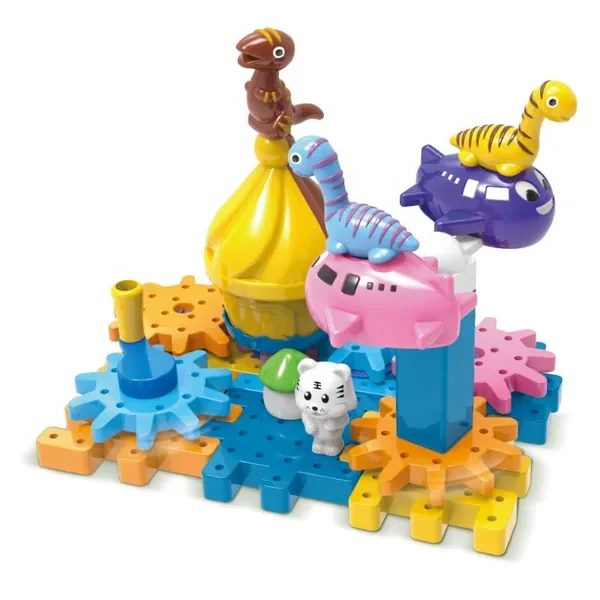
The animal set offers immediate model recognition; the pirate reference offers scene storytelling and a joining mechanism to explore. TBS-304106 contains 36 pieces in ABS and comes in a color box. Ask to see a supplied animal model assembled, then view it from the angle you would use for a listing’s main image. The useful question is whether the completed shape communicates its subject without a lengthy caption.
Its recorded package measures 25 cm × 18 cm × 7 cm. Have the box placed beside the model: this connects the gift presentation to the construction inside, while keeping package size distinct from finished-model scale. A clear animal identity and an understandable box-to-build relationship are more relevant here than treating 36 pieces as an automatic measure of appeal.
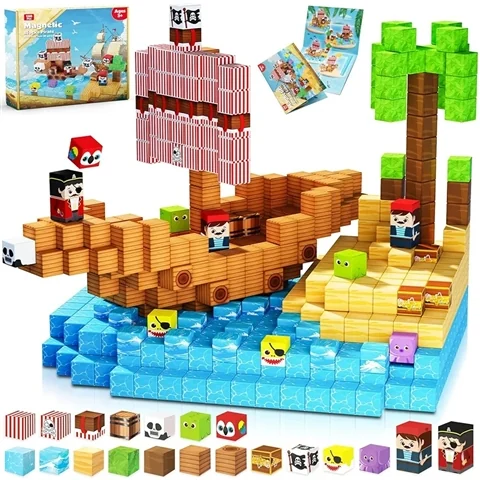
TBS-339880 takes a different route. The catalogue photograph shows a pirate ship and island built from printed cubes; the catalogue specifies ABS and magnetic connection on four sides. Ask for a contents-led scene build, followed by a close view of the joining and separation. That reveals both the setting and the construction method.
The record gives a package size of 22 cm × 20.8 cm × 2.5 cm and describes static magnetic construction without electronics or batteries. At the fair, compare the retail pack with the assembled scene rather than reading those measurements as a ship footprint. For themed magnetic blocks, the strongest presentation may combine a scene photograph with a close connection demonstration.
Action: follow the dinosaur ball from release to finish
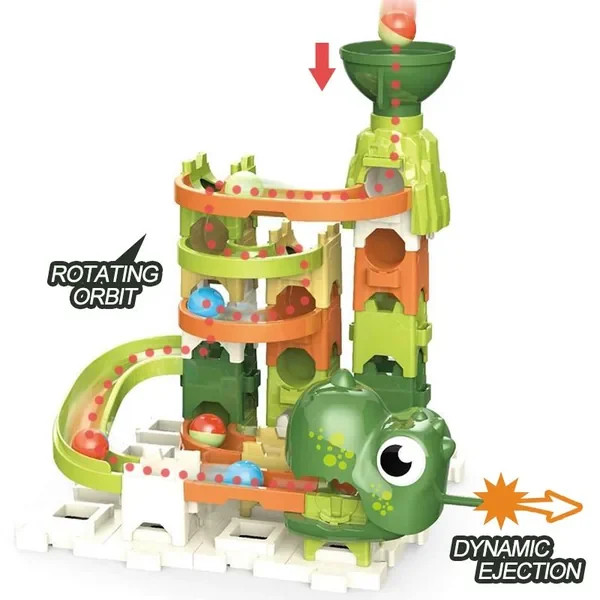
TBS-274008 combines an ABS dinosaur construction, a rolling-ball route and an advertised 3-in-1 building proposition. It requires no battery. This is the candidate to prioritize when your fair conversations need something observable after assembly: the dinosaur supplies the theme, while the moving ball supplies a beginning and an outcome.
Request a demonstration with the entire route visible, from release through the finish, followed by the reset. That lets you judge whether a short video could explain the play without cutting between disconnected details. Watch the model and the ball together; an attractive dinosaur close-up answers a different question from a readable track demonstration.
The color box measures 45 cm × 12 cm × 35 cm. Compared with the animal set’s 25 cm × 18 cm × 7 cm package, this reference gives you a different retail-presentation conversation: how does the larger box explain the route and the finished construction? Then turn to the instructions for the three advertised configurations. Identify the reused parts and the rebuilding sequence so the 3-in-1 proposition becomes a documented choice of constructions, not merely a badge beside the action.
Rebuilding: make the robot’s change of form the story
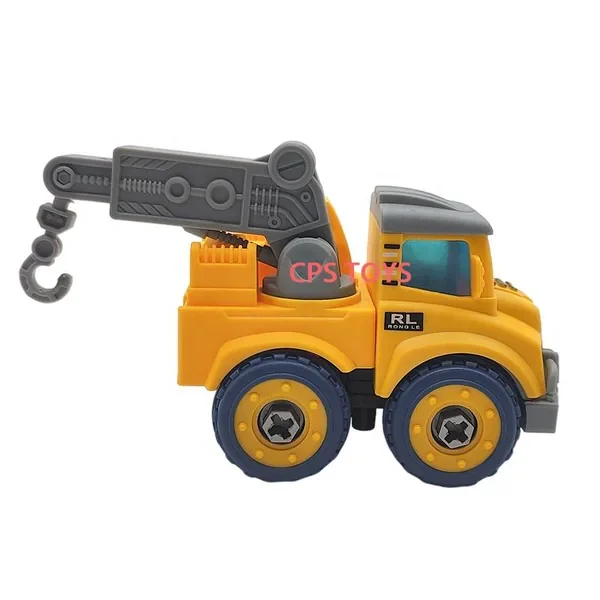
TBS-241361 is a yellow plastic 5-in-1 take-apart engineering-vehicle robot. Here, the interesting action is the building process itself. Ask for a continuous assembly demonstration showing how the advertised forms relate, which components are removed and how they return in another construction.
Its recorded retail presentation is a PVC bag with card, measuring 28 cm × 34 cm × 5 cm. That differs materially from the animal set’s color box: examine the actual bag-and-card presentation beside the assembled robot and consider how clearly it explains the construction story. For a gift or ecommerce listing, the pack and the finished object need to communicate the same proposition.
Include the supplied contents in the demonstration so tool inclusion is established directly. Then use the instructions to follow the advertised five-form relationship. A construction specialist may find the intermediate stages more informative than another finished pose: they reveal what the builder actually does. Give that process space in the meeting rather than asking for an instant transformation that the take-apart description does not promise.
Finished models: vehicle combination versus floral composition
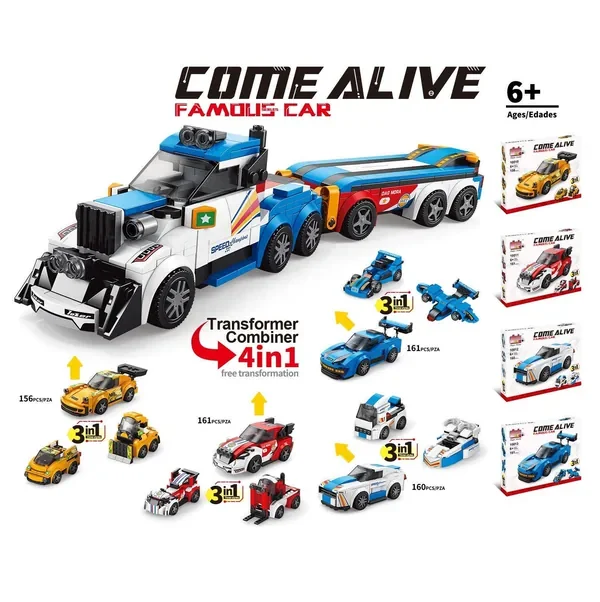
For TBS-257799, focus on the photographed vehicle family: a four-vehicle combiner presentation with a 4-in-1 graphic. This makes an interesting counterpart to the robot because the relationship between the component vehicles and the combined model can become the central discovery.
Ask the demonstrator to lay out the relevant components and instructions, then show how the vehicle forms relate to the combined construction. Record which forms the instructions cover and what remains assembled during the change. For a wholesale vehicle-building assortment, that is more useful than ranking an uncertain piece count: it tells you which photographed product story the supplied construction can support.
TBS-286102 shifts attention from combination to composition. It is an ABS floral stacking construction set. Ask to see an arrangement made from the supplied contents, then a rearrangement using those same contents. Examine the overall shape, spacing and camera angle as a potential gift-listing image.
These finished-model conversations should produce different records. For the vehicle candidate, retain the documented relationship between builds. For the flowers, retain an achievable arrangement and the contents used to make it. Neither needs an invented moving feature to justify attention; the attraction is what the completed construction communicates.
Which references deserve priority for your channel?
Prioritize the animal and floral references for image-led gift discovery, the dinosaur for a complete short-video action, and the robot and vehicle combiner for construction-led storytelling. Give the pirate reference priority when your assortment needs a recognizable scene supported by a visible magnetic joining method.
The distinction is not static versus exciting. An animal silhouette can explain a product quickly; a floral arrangement can provide its central image; a ball route can make the outcome legible; and rebuilding can sustain a more detailed demonstration. At the fair, record each candidate’s strongest attraction and the specific demonstration that would let your channel communicate it accurately.
Add an instruction-led counterpoint to the action shortlist
TBS-269331 provides a second robot proposition with 832 pieces, giving a construction specialist a more detailed instruction-review subject than the 5-in-1 take-apart label alone. Its photographed box is 45 × 33 × 7 cm, so compare the instruction spread and parts layout with that specific retail presentation. The 832-piece quantity describes the construction inventory; it does not predict assembly time or establish that a transformation happens without rebuilding.
The saved catalogue price for the 36-piece animal reference is USD 1.22 to USD 1.34 per selling unit, making it the lower-priced subject on this comparison sheet. The dinosaur reference is recorded at USD 4.53 to USD 5.36, directing attention to the complete rolling-ball action. The engineering robot is recorded at USD 3.08 to USD 3.52, making the demonstrated take-apart sequence its own proposition. The floral reference is recorded at USD 3.40 to USD 3.96, so its case rests on the supplied arrangement and construction. The pirate scene is recorded at USD 6.09 to USD 6.37, a reason to examine the actual contents behind the dramatic scene photograph.
Those saved price fields are catalogue references, not current quotes or retail margins; commercial quantity, packaging and shipment terms remain outside this comparison. Use the contrasts to prioritize different demonstrations, without treating the uncertain vehicle-combiner quantity or its price as an approved offer.
How do you turn the shortlist into business meetings?
Use the official matching period for focused meeting requests and Scan2Match to connect on-site discoveries with follow-up. The published schedule lists for December 11, 2026–February 10, 2027, and Click2Match for January 4–21, 2027. Those periods extend the conversation beyond the physical exhibition. .
Frame an enquiry around the reference or construction type, your channel and the demonstration objective—for example, a complete dinosaur ball route followed by the configuration instructions. This gives a relevant supplier a concrete discussion to prepare rather than an open-ended request to show everything.
At the fair, Scan2Match in the Marketplace App scans exhibitor booth or product QR codes to access details, favourites, chat, enquiries and meeting-scheduling functions. Attach the unresolved demonstration question to the enquiry so a later discussion advances your comparison. .
Your next step: use the official buyer-registration route
Open the and follow To Visit to buyer registration. procedure collects personal and company information and business-matching interests, then sends an email after successful registration. If registration is not yet ready, the site may display an information-coming-soon message. Use your channel focus to make those matching interests specific.
For arrival planning, the official overview identifies the Harbour Road entrance at HKCEC, 1 Expo Drive, Wan Chai. The venue places Exhibition Centre MTR station, Wan Chai MTR station and Wan Chai ferry pier within a ten-minute walk. Bring a discovery brief organized around the attraction you need to see—not simply the products you already recognize.