
A gift-channel buyer opening a January range review has three car building toys on the table: a 480-piece brick coupe with a pull-back chassis, a 96-piece magnetic building car with snap-in wheels, and a 310-piece marble-run track element shaped like a downhill road. They look like one theme. They are three different approval paths, three different sales units and three different documentation files, and the first job is to stop treating them as one SKU.
This brief sets the boundary before the trend: pull-back spring cars sit inside Creative Construction Toys or Brick Building Sets, while standalone programmable or RC kits are excluded from scope. Magnetic tracks belong to magnetic-building; non-magnetic buildable tracks belong to marble-run-blocks. Theme, age and piece system are separate attributes, and piece count is never order quantity.
The market context is real but narrow. ed U.S. toy dollar sales up +20% from January through September 2026 versus the same period last year, with units +18% and ASP +2%, and consumers aged 12 and older accounted for the majority of that growth. Building Sets grew +17% in the same window, driven by LEGO Botanical Collection — a botanical display line, not vehicles. That distinction governs every number in this article.
What the U.S. Building Sets base actually justifies for a car program
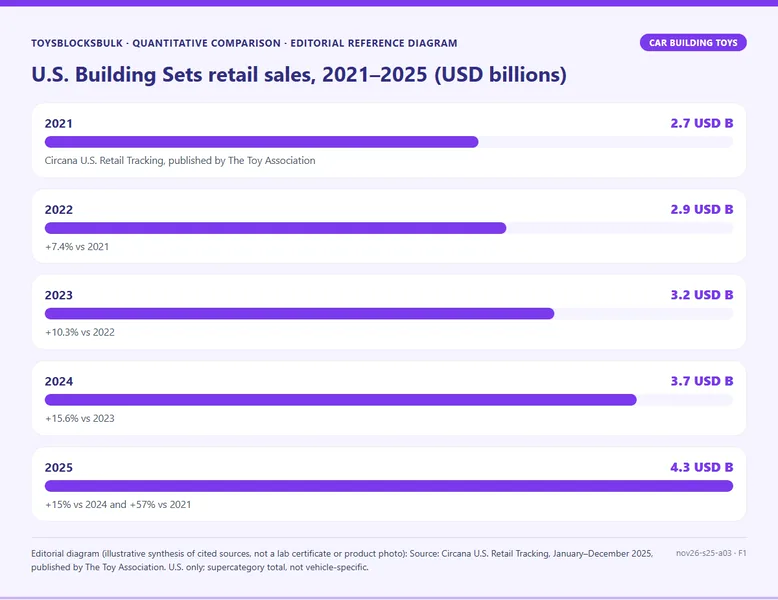
U.S. Building Sets retail sales were $2.7B in 2021, $2.9B in 2022, $3.2B in 2023, $3.7B in 2024 and $4.3B in 2025, equal to +15% vs 2024 and +57% vs 2021. That five-year trajectory supports a multi-tier car program rather than a single test SKU, because the category base absorbed $1.6B of new dollars in four years.
Here is the illustrative planning calculation, framed as arithmetic on published category totals and not as a forecast. Growth 2021→2025 = 4.3 − 2.7 = $1.6B. Computed growth rate = 1.6 / 2.7 = 59.26%, while the source states +57% because adjusts its own series. A buyer's own 0.5% share assumption of the $4.3B 2025 base = 0.005 × 4.3 = $21.5M. The $21.5M is the buyer's assumption, not a source figure, and the 59.26% should be quoted as the source's +57% to avoid overstating precision.
Two adjacent figures keep the brief honest. The U.S. Vehicles supercategory stood at $1.9B in 2025, -1% vs 2024 and +2% vs 2021 — vehicle-themed toys as a whole were flat, so a car building toy cannot borrow vehicle-category momentum. Globally, toy sales reached $123.0B in 2025, up 8% over 2024 and +24% over five years at a +4% CAGR since 2020, which supports international range planning but says nothing about car-specific demand.
The demand-side signal is co-play and display. 2026 U.S. Holiday Purchase Intentions Study of 3,534 consumers found expected average holiday spending of $779 vs $796 last year, with Q4 2026 holiday spending forecast between a 1% decline and a 2.5% increase. NRF's October survey found 27% of holiday shoppers plan to give an experiential gift, up from 19% five years ago. Flat-to-slightly-down spend plus selective gifting means the car set should be positioned on shared build time and display value, with a lower-entry tier planned alongside any hero SKU.
Three mechanism tiers, three approval paths
Tier one is brick bodywork with a pull-back chassis. The spring-and-gear assembly is a separate sample-approval item: request the bare chassis, record pull stroke in millimeters, gear ratio, return-travel distance and a 10-pull bench cycle before bodywork tooling is locked. As an illustrative engineering example, a 3.0:1 spring-to-axle gear ratio with a 120 mm pull stroke stores 120 ÷ 3.0 = 40 mm of axle travel per full pull, so 10 pulls total 1,200 mm of pull and 400 mm of axle rotation. That is a planning record, not a lab test.
Tier two is magnetic building car components — magnetic rods, plates or snap-in wheel modules. Magnetic rods are not magnetic tiles, and the listing must name the exact component type. Approval evidence is the magnet grade declared in writing, the pole-orientation drawing, and a pull-force check on the wheel module at the assembled body length.
Tier three is a non-magnetic buildable marble-run track element shaped as a road or ramp. It belongs to Marble Run Building Sets, not to magnetic-building, and it must be sampled with the actual ball or vehicle runner specified, because track pitch and joint tolerance decide whether the element works at all.
Display-worthy bodywork is a named approval attribute across all three tiers. The Toy Association's 2026 trend briefing states kidults account for roughly one-quarter of U.S. toy sales, that 81% of parents in 2025 were likely to add a toy or game for themselves to their holiday list (up from 72% the year prior), and that toymakers are balancing play value with display appeal, nostalgia and premium finishes. Specify finish, proportion, and whether a stand or plaque is included — as trend context, not as proof any specific car SKU will sell.
Car building toy tiers compared on buyer-verifiable attributes
Use this matrix to separate the three car building toy tiers before any quotation request. Each row carries its own mechanism, its own pull-back applicability and its own out-of-scope flag, so a single listing never mixes claims across construction systems.
| Tier | Out-of-scope flag | Construction mechanism | Pull-back applicability | Display styling evidence | Complexity-tier documentation |
|---|---|---|---|---|---|
| Brick bodywork with pull-back chassis | Standalone RC or programmable chassis | Brick Building Sets / Creative Construction Toys | Yes — spring-and-gear assembly sampled separately | Finish swatch, proportion drawing, stand or plaque spec | Instruction step count + part count per tier |
| Magnetic building car components | Magnetic rods described as magnetic tiles | Magnetic Building Toys | No — friction or free-roll only | Component colorway lock, wheel-module drawing | Component count + magnet grade declaration |
| Marble-run track car element | Non-magnetic track listed as magnetic-building | Marble Run Building Sets | No — gravity-run track | Track pitch drawing, joint tolerance spec | Track piece count + runner compatibility list |
| Co-build gift set (any tier) | Child-age suitability inferred from piece size | Tier inherits parent mechanism | Only if parent tier carries a spring chassis | Two-audience packaging proof + build-time estimate | Age grading as separate item-specific attribute |
Age-graded complexity tiers without borrowed safety claims
Document complexity with two countable fields per tier: instruction step count and part count. An entry tier might run 40 steps and 180 parts, a co-build tier 90 steps and 480 parts, a display tier 160 steps and 900 parts — those are the buyer's own tier definitions, recorded in the range plan, not supplier marketing language.
Age grading stays a separate item-specific attribute. The American Academy of Pediatrics advises that the best toys match a child's developmental skills and abilities, and age-and-stage guidance lists blocks that snap together for 2-year-olds while noting each child develops at an individual pace. Both are developmental guides, not item-specific safety grades, and ToysBlocksBulk policy bars child-age suitability claims without item-specific evidence. Large pieces do not imply baby-safe.
Co-building is an audience and occasion statement, not an age claim. Write it as 'shared build session, two builders, 90-minute session at 90 instruction steps' and attach the instruction-quality evidence: exploded-view drawings, color-coded part callouts, and a step-to-part ratio the buyer can check against the sample.
Approval sequence: five gates before quotation approval
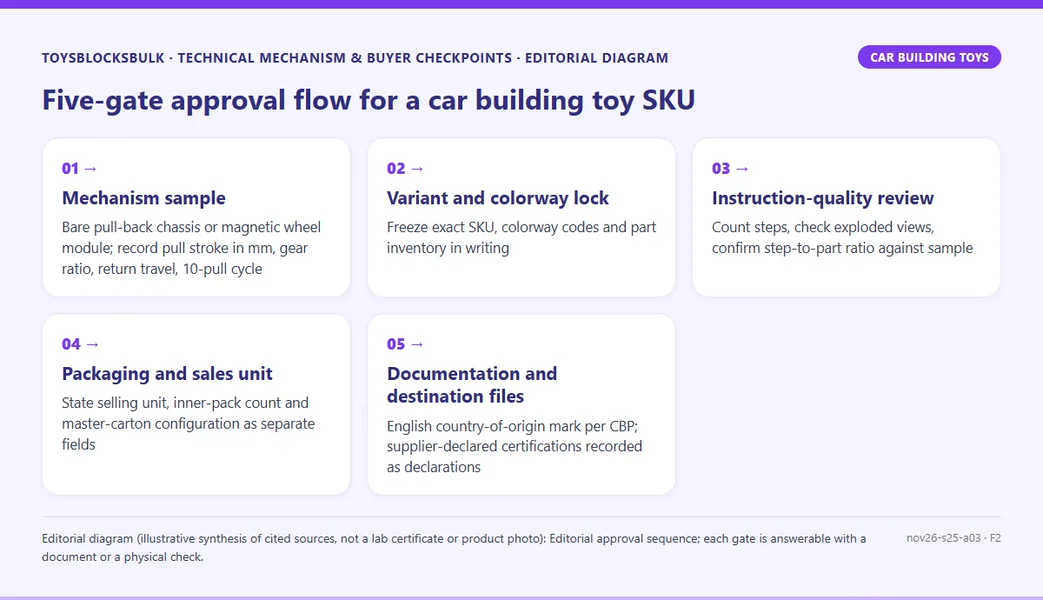
Gate 1 — mechanism sample. Receive the bare pull-back chassis or magnetic wheel module, record pull stroke in millimeters, gear ratio and return travel, and run a 10-pull bench cycle. Gate 2 — variant and colorway lock. Freeze the exact SKU, colorway codes and part inventory in writing. Gate 3 — instruction-quality review. Count steps, check exploded views and confirm the step-to-part ratio against the sample. Gate 4 — packaging and sales-unit confirmation. State the selling unit, inner-pack count and master-carton configuration as separate fields; never infer MOQ from piece count or master-carton dimensions from parcel dimensions. Gate 5 — documentation and destination files. Confirm the English country-of-origin mark required on every article of foreign origin entering the United States, plus supplier-declared certification files recorded as declarations, not verified compliance.
Secondary-keyword discipline: marble run, magnetic blocks and the car listing
The four secondary keywords map onto the site's five categories, and each one pulls a car listing toward a different mechanism. Marble run and marble run toy belong to Marble Run Building Sets when the track is non-magnetic and buildable. Childrens magnetic blocks and magnetic building blocks belong to Magnetic Building Toys. None of the four belongs in the title of a brick pull-back car SKU.
Keep a car-themed listing inside one mechanism. A brick pull-back coupe carries Brick Building Sets attributes only. A magnetic car module carries Magnetic Building Toys attributes only. A downhill road track carries Marble Run Building Sets attributes only. Cross-mechanism claims — 'magnetic marble run car' — fail the first approval gate because no single sample can evidence both systems.
Sourcing geography supports the range plan without proving any SKU. Chenghai district in Shantou hosts about 68,100 toy production and trading entities with roughly 200,000 direct workers, and its 2025 full-chain toy output value exceeded RMB 50 billion; building-block capacity there is about half of China's national total and one-third of the global total. The 25th Shantou Chenghai International Toy & Gift Fair covered 100,000 sq m across 11 halls with more than 2,500 brands and over 300,000 products, drawing participants from 55 countries and regions. Those figures describe supply depth, not your car SKU's sell-through.
Is a pull-back car building toy the same as an RC car kit?
No. A pull-back spring mechanism is a construction-play feature inside Creative Construction Toys or Brick Building Sets, while standalone programmable or RC kits are excluded from scope. Confirm the mechanism type in writing and sample the spring assembly before approving bodywork.
Can I use the 2026 Building Sets growth figure to forecast car building toy sales?
Only as category context. The +17% January–September 2026 U.S. Building Sets growth cited by was driven by LEGO Botanical Collection, and the $4.3B 2025 figure is a supercategory total — neither is vehicle-specific. Car demand needs its own sample, sell-through and reorder evidence.
How do I position a car building toy for adult-kid co-building without claiming child-age suitability?
Frame co-building as an audience and occasion statement supported by instruction quality and complexity-tier documentation, and keep age grading as a separate item-specific attribute. ToysBlocksBulk policy bars child-age suitability claims without item-specific evidence, and large pieces do not imply baby-safe.
Build the car tier list, then request the sample
Send the range plan with three tiers named by mechanism — brick pull-back, magnetic car module, marble-run track car — plus instruction step counts, part counts, selling unit and colorway codes. ToysBlocksBulk supports product comparison, sampling, private-label packing, reorder version control and shipment preparation, and agrees selling units, packaging, documentation and delivery terms before quotation approval.
Attach the pre-quotation checklist: bare chassis sample, magnet grade declaration, track pitch drawing, instruction step count, country-of-origin mark file and supplier-declared certification list. Each field is answerable with a document or a physical check, which is what makes the quotation comparable.
Sources
stgsl.shantou.gov.cn — 融媒观察 | 澄海把玩具的门开给世_图片新闻_汕头市工商业联合会(总商会)
www.cbp.gov — Marking of Country of Origin on U.S. Imports | U.S. Customs and Border Protection