
Approve bulk truck building sets only when the physical sample matches the agreed written specification for its connection mechanism, exact variant, piece inventory, function, instructions, and packaging. Record accepted, failed, or not checked for each requirement, then issue an approve, hold, or reject decision with named responsibility. The first review establishes whether the sample meets your requirements; only after written approval should that sample become a retained production reference for the specified version.
For a truck assortment, a convincing finished model is not enough. The supplied parts must build the promised configuration, the instructions must explain that build, and the selling unit must contain what its packaging claims.
Which Sample Can Become the Production Reference?
| Development or marketing sample | Use it to discuss appearance, construction ideas, and design changes. Record any substitute parts or packaging. Do not use it alone to release the specified bulk version. |
|---|---|
| Pre-production sample awaiting approval | Compare it with the agreed specification, drawings, parts inventory, instructions, and packaging artwork. It is an approval candidate, not yet the approved reference. |
| Approved and retained pre-production sample | Identify the approved version in writing and retain it as a physical comparison reference. Use it alongside the specification and authorized change records during production inspection. |
What Exactly Is Being Approved?
Approve one identifiable item and variant against a named specification revision, rather than approving a product family or a photograph.
Record the supplier item reference, sample ID, sample type, receipt date, truck configuration, color allocation, intended assortment use, and packaging version. Ask the supplier to confirm whether the sample uses the planned production materials and processes, and list any exceptions before inspection.
Identify the connection mechanism physically. A truck theme does not establish whether the product uses interlocking bricks, large blocks, magnetic connections, or another construction system. Keep theme, intended age, and piece system as separate attributes; a hand check does not determine age suitability.
For a multi-build set, state whether the advertised models are alternative builds from shared pieces or models that can be assembled simultaneously. That distinction changes the inventory and instruction checks.
What Should the Physical Sample Inspection Cover?
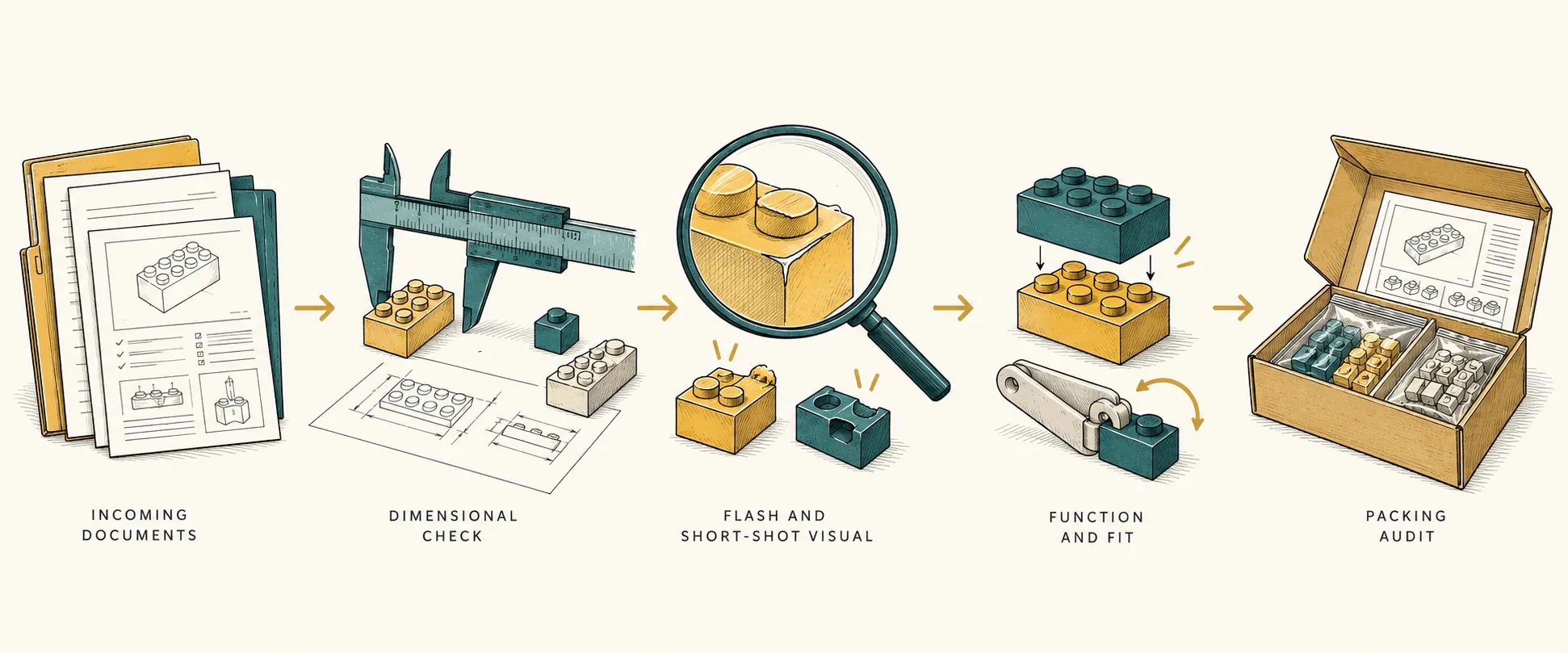
| 1. Connection mechanism and truck function | Compare with the design requirements and intended connection system. Assemble the truck using the supplied instructions; check specified joints, wheel rotation, axle alignment, and any promised steering, tipping, or articulation. Record binding, unintended separation, or a feature that cannot operate as described. Hold the affected requirement for correction; approve only the functions actually checked. |
|---|---|
| 2. Piece inventory and sales unit | Sort and count parts by type, size, and color against the agreed bill of materials or illustrated inventory. Reconcile spare pieces, accessories, and shared parts for alternative builds. Check one complete intended sales unit—not merely the outer display. A missing required part, incompatible substitute, or unresolved counting basis triggers inventory correction and a rebuild before acceptance. |
| 3. Materials and component identity | Compare component descriptions and material declarations with the written specification. Inspect for visibly substituted components and record identifying marks where present. Appearance or touch cannot verify polymer grade or chemical composition. Record the observable match separately from documentary or laboratory verification; hold a claimed material requirement when its agreed evidence has not been checked. |
| 4. Finish and workmanship | Examine molding, edges, attachment areas, printed details, stickers, and color consistency against the agreed finish requirements. Record visible flash, cracks, incomplete molding, peeling decoration, or misaligned graphics by part and location. Request replacement or correction when the agreed limit is exceeded. Suspected safety-related defects need appropriate technical assessment, not a cosmetic concession. |
| 5. Dimensions and fit | Measure the dimensions named in the drawing or specification, including critical mating features and assembled dimensions where specified. Record the instrument, measurement points, target, tolerance, and actual result. An out-of-tolerance measurement fails that criterion; investigate the part and its effect on fit before deciding on a revised sample. |
| 6. Instruction quality | Build from the supplied instruction revision rather than from a supplier demonstration. Check part identification, sequence, orientation, diagrams, language, and coverage of each promised configuration. Record the exact step where a build becomes ambiguous or requires an unlisted part. Require corrected instructions and repeat the affected build before closing the issue. |
| 7. Agreed packaging and presentation | Compare the actual selling unit with the packaging specification and artwork revision. Check format, internal bags or trays, component separation, closure, product identity, piece-count claim, included contents, and agreed label placement. For a display box, verify how individual saleable sets are identified. Hold mismatched artwork or contents for correction; packaging approval does not establish transport performance or regulatory compliance. |
How Does the 4-in-1 Car-and-Truck Example Change the Check?
For a 4-in-1 car-and-truck set, resolve the relationship between the piece-count claim, the individual saleable set, and the display box before accepting the inventory.
The catalog entry for the 4-in-1 car-and-truck construction set names 1,152 pieces, records the material as plastic, and lists display-box packing. These are starting descriptions for the inspection—not a counted inventory, a verified polymer grade, or proof that each individual set contains the stated total.
Write the approval target as: “Each agreed sales unit contains the parts in inventory revision [enter revision] and builds the configurations stated in instruction revision [enter revision].” Then open the sample, identify the saleable unit, count its parts, and reconcile that count with the packaging claim.
If the physical count matches an agreed inventory but the display artwork describes a different counting basis, mark the inventory check accepted and the artwork check failed. Hold overall approval until the discrepancy is resolved. Do not discard valid inventory evidence, and do not turn a packaging mismatch into a claim that the whole construction system has failed.
Sample-Approval Record
| Record identity and revision | Enter approval-record ID, record revision, supplier item reference, variant, sample ID, sample type, receipt date, and inspection date. |
|---|---|
| Controlling requirements | Identify the agreed specification, drawing, inventory, instruction, packaging-artwork, and change-record revisions used for this review. State the intended sales unit and configuration coverage. |
| Production representation | Record the supplier's written confirmation of planned bulk materials, components, process, and packaging. List any sample-only substitutions and the requirements they affect. |
| Criterion and specified target | For each check, enter the requirement, target value or condition, agreed tolerance where applicable, and inspection method. Identify which unresolved requirements block release. |
| Observed result | Enter the actual count, measurement, build outcome, or visible condition. Distinguish direct observations from supplier declarations and document-review conclusions. |
| Result and evidence reference | Mark accepted, failed, or not checked. Cite the relevant inventory sheet, measurement record, instruction step, photograph, video, declaration, or test report as appropriate. |
| Discrepancy and corrective action | Describe the difference from the specified target, affected components or documents, required correction, action owner, and agreed due date. State whether a revised physical sample is needed. |
| Overall decision and conditions | Select approve, hold, or reject. Define exactly what the decision covers and whether production release is authorized. Record any expressly accepted commercial deviation and its item, revision, or lot scope. |
| Responsible approval | Enter the inspector's name and date, responsible buyer approver's name and role, approval signature or controlled electronic authorization, and decision date. Identify any separate technical approval still required. |
| Follow-up closure and retained reference | Record the corrected sample or document revision, recheck results, closure evidence, closure approver, and closure date. After approval, enter the retained-sample ID, storage locations, and purchase-order reference. |
Which Evidence Must Stay Separate from the Hand Inspection?
Keep commercial sample acceptance separate from safety testing, age assessment, and destination-specific document review.
A successful build establishes only the functions observed under the recorded conditions. It does not establish chemical safety, performance under specified laboratory mechanical tests, or age suitability. Do not improvise a pliers or pull check and describe it as a compliance test. Use the applicable laboratory method for a safety conclusion. A visual pass does not replace testing. How to Approve Samples
Record supplier-declared certifications as declarations until the relevant item-specific documents have been reviewed. Request documents that identify the product and tested construction, and assess their coverage against the intended destination and requirements. A different internal item code alone does not automatically require a new test; changes to construction or applicable requirements need a coverage review.
Maintain a separate destination-document section in the purchasing file. Do not mark that review accepted merely because the physical sample looks right, and do not label the entire sample review invalid because one photograph is absent when other adequate inspection evidence exists.
When Should the Team Approve, Hold, or Reject?
Approve when release-blocking requirements are accepted, hold when a correctable discrepancy or essential unchecked requirement remains open, and reject when the submitted version is not accepted and must be replaced or redesigned.
An approval with conditions must state whether it authorizes production. If a condition still affects required inventory, fit, function, packaging claims, or necessary technical evidence, keep release on hold. Do not use a general “approved subject to comments” message that leaves the factory to interpret the comments.
For a discrepancy, identify the failed target, send a specific correction request, name the action owner, and agree a recheck date. When a revised sample arrives, recheck all essential requirements—not just the last correction—because a change can affect other dimensions or functions. From Sample to Mass Production
A written commercial concession should identify its exact scope and must not be treated as a waiver of applicable safety requirements. A proposed product change reopens the affected approval until the revised specification and supporting evidence are accepted. From Samples to Bulk Orders
What Happens After Sample Approval?
After written approval, label and retain the approved sample, link it to the controlled specification, and use both for the next-stage bulk comparison.
Seal or otherwise protect the reference against accidental mixing, date it, identify its approved revision, and photograph useful details. Where practical, retain matching approved references with the buyer and factory. Photographs support traceability; they are not the only valid inspection evidence.
Cite the approved sample ID and controlling specification revisions in the purchase order, and obtain confirmation that the production team has received the correct versions. The purchase order's sample reference gives subsequent inspection a clear comparison point. How to Approve Samples
Compare early production and later bulk inspection samples with the written requirements, retained reference, and authorized changes. Sample approval does not prove that every bulk unit matches. If bulk goods differ, record the actual deviation, assess it against the agreed tolerance, and apply the agreed correction process. The record supports traceability; it cannot by itself reveal an undisclosed production change.