
A packaging-only pilot means you re-run an existing, already-approved truck building set in new packaging — new retail box artwork, new insert, new label panel — while the toy itself, its moulds, its piece inventory and its connection mechanism stay untouched. That is the whole point: you isolate one variable, so if the pilot fails you know exactly why. For bulk truck building sets, this is the cheapest way to test a retail-ready box, a bilingual label panel, or a shelf-ready display before you commit to a full production run.
The decision rule is simple. Run a packaging-only pilot if your toy is already in production and only the box, label or insert changes. Do not run one if the piece count, the connection mechanism, the moulds or the age grading are also changing — that is a new product, and it needs a new approval path, not a pilot.
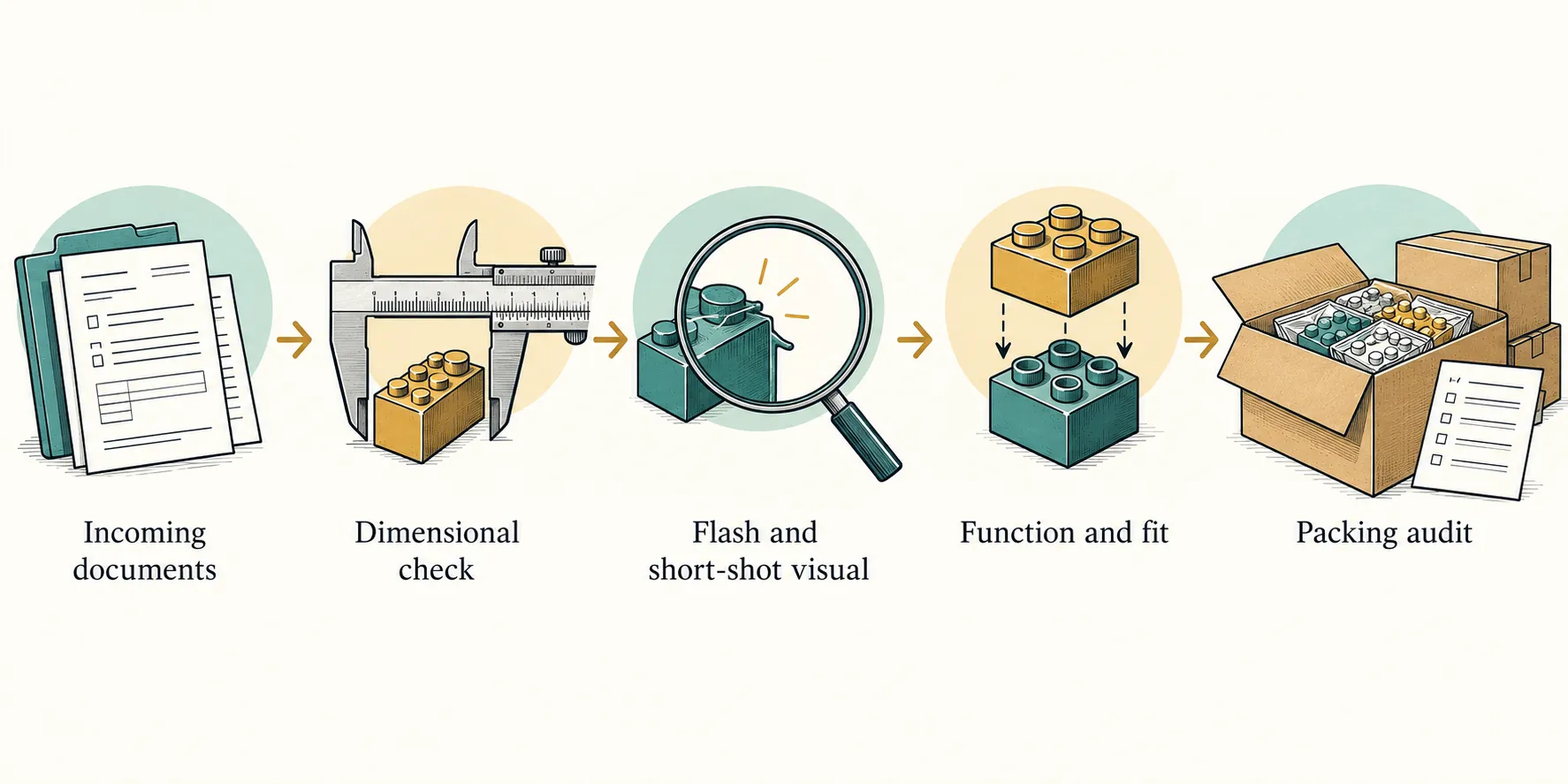
What actually changes in a packaging-only pilot — and what must be frozen
Freeze the product, vary the package. Write that on the top of the pilot file. Anything on the frozen list that moves turns your pilot into a new-product approval, and the pilot data becomes unusable.
Changeable in a packaging-only pilot: retail box dimensions and artwork, insert or tray, polybag count per box, label panel content, instruction sheet layout, display or shelf-ready configuration, and the master carton if the retail box dimensions change.
Frozen: connection mechanism, piece count and piece inventory, moulds and tooling, material, colour of the parts, age grading, and the safety test report that covers the toy as tested. If the retail box becomes a keep-and-store case or a play item, it stops being throwaway packaging — treat it as part of the toy and confirm the applicable limits before you print, including the 90 ppm lead limit for paint and surface coatings in 16 CFR 1303 Toy Labeling Requirements.
One caution that catches importers: packaging with independent play value can be treated as a toy or article intended for children, which pulls it into US consumer product safety authority-administered toy safety standards and tests. US consumer product safety authority staff look at manufacturer intent, advertising and marketing, and the design and play value of the packaging itself Packaging with "Play" Value. A truck-shaped carton that a child keeps and plays with is not the same risk category as a plain printed box.
The label panel is where a packaging-only pilot usually fails
Artwork is easy. The label panel is where pilots get rejected at the port or at retail. Build the panel against the destination market's rules, not against a supplier's template.
For the United States, a US children's product safety rules tracking label must identify the manufacturer or private labeler, the place and date of production, and a batch or run number, and a decodable code is acceptable if a consumer can find out how to decode it. The mark goes on the product and on its packaging to the extent practicable; if the product is too small to mark, the packaging still carries it Toy Labeling Requirements.
Where a choking hazard warning is required for toys and games intended for children 3 to under 6 that contain small parts, it must be visible on the principal display panel. Small packages with a principal display panel of 15 square inches or less may use a referral statement on the front and the full warning on another panel Toy Labeling Requirements.
Imported toys must be marked in English with the country of origin, legibly and permanently enough to reach the final buyer under 19 CFR Part 134. A sealed retail box that buyers do not normally open before purchase must show the origin of what is inside, even when the item itself is marked; if the box shows a U.S. address, the country of origin has to appear near it Toy Labeling Requirements.
Beyond the statutory items, a publisher's recommendation worth adopting as a buyer checklist: put manufacturing location, batch and model number, and sourcing details on the label, and include age range, piece count and operating requirements on the package Overview on Toy Packaging Requirements and Standards. Treat that as good practice, not as a legal citation. The same source notes printed package labels suit wooden or plastic toys, while woven side labels are preferred for soft toys — relevant if your assortment mixes hard construction sets with plush.
Worked comparison: two catalog records, two different pilot shapes
Take two recorded truck-and-car building items from the scoped catalog snapshot dated 2026-10-09. The first is a 64-piece dual truck DIY building blocks construction track maze set in a colours box, with a reference MOQ of 54 and 18 units per carton. The second is a 140-piece big building blocks car kit in a colour box, with a reference MOQ of 36 and 12 units per carton.
The arithmetic matters more than the numbers. For the 64-piece item, a 54-unit order is exactly three cartons (54 ÷ 18 = 3), so the reference MOQ lands on a clean carton multiple. For the 140-piece item, a 36-unit order is exactly three cartons (36 ÷ 12 = 3) — also clean. That is a coincidence of these two records, not a rule. A reference MOQ is a minimum order quantity, not an order multiple; do not assume you must round every order up to a full carton unless the supplier states a full-carton order restriction in writing.
Use the pilot to test the thing that actually differs between these two: the 64-piece set is a track-maze construction item, so the box has to communicate a buildable track and the piece inventory that supports it. The 140-piece set is a car kit, so the box sells a vehicle build. Same category family, different shelf story, different insert. A packaging-only pilot on both, run in the same window, tells you which box reads better before you scale either.
What the catalog record does not give you: verified certification, safe age, current price, stock, or factory capacity. Reconfirm the sample, the current quote, the age evidence and the destination documents before you print anything.
Pilot file: what to specify, what to confirm, what to leave open
| Product variable | Frozen — connection mechanism, piece count, moulds, material, age grading |
|---|---|
| Package variable | Changeable — retail box artwork and dimensions, insert, polybag count, display configuration |
| Label panel | Build against destination rules; do not copy a supplier template |
| US tracking label | Manufacturer or private labeler, place and date of production, batch or run number; decodable code acceptable |
| Choking hazard warning | Principal display panel where required for children 3 to under 6 with small parts; small-panel referral statement allowed |
| Country of origin | English marking on imported toys under 19 CFR Part 134; sealed retail box must show origin of contents |
| Keep-and-store packaging | Treated as part of the toy; confirm applicable limits including 90 ppm lead in paint and surface coatings (16 CFR 1303) |
| Play-value packaging | May be treated as a toy; US consumer product safety authority staff weigh intent, marketing, design and play value |
| Reference MOQ (64-piece truck set) | 54 units; 18 units per carton |
| Reference MOQ (140-piece car kit) | 36 units; 12 units per carton |
| Order multiple | Not established by these records; confirm in writing, do not infer from carton quantity |
| Master carton dimensions | Not established by these records; do not infer from parcel dimensions |
How to run the pilot without turning it into a full rollout
Scope it to one SKU and one package change. Two changes at once and you cannot attribute the result. If you want to test a bilingual panel and a new insert, run two pilot cells, not one combined box.
Sequence the approvals before you print. Artwork proof, then a physical pre-production sample of the box with the label panel applied, then the label check against the destination rules, then the print run. Printing first and checking labels after is how importers eat a full box run.
Keep the pilot quantity small and the documentation complete. The pilot file should hold the frozen list, the change list, the label panel proof, the pre-production sample photos, and the written confirmation of MOQ, order multiple and carton configuration. That file is what you hand to a buyer or a compliance reviewer when you decide whether to scale.
Set a decision gate. If the box passes the label check and the pre-production sample matches the proof, scale. If the label panel fails, fix the panel and re-run the pilot cell — do not scale on a promise that the panel will be corrected in the main run.
Packaging-only pilot questions buyers ask before committing
Can I change the retail box without retesting the toy?
The toy as tested stays frozen, so a box artwork change does not change the tested construction. But if the new packaging is kept and played with or used for storage, it becomes a component of the product and has to meet the same limits, including the 90 ppm lead limit for paint and surface coatings in 16 CFR 1303. Confirm with your testing partner before you print.
Does the reference MOQ mean I must order full cartons?
No. A reference MOQ is a minimum order quantity, not an order multiple. A carton quantity is not automatically an order multiple either. Unless the supplier states a full-carton order restriction in writing, do not assume you must round every order up to a full carton.
Can I use the parcel dimensions as the master carton size?
No. Parcel dimensions describe the individual item or its retail pack. Master carton dimensions are a separate specification and must be confirmed as a carton figure, not inferred from the parcel.
Is a supplier-declared certificate enough for the pilot?
A supplier declaration is a commercial document, not verified compliance. For a pilot, ask for the report that covers the toy as tested, check that the construction in the report matches what you are buying, and keep the destination documents with the pilot file.
What if the packaging has its own play value?
Packaging with independent play value can be treated as a toy or article intended for children, which brings in US consumer product safety authority-administered toy safety standards and tests. US consumer product safety authority staff look at manufacturer intent, advertising and marketing, and the design and play value of the packaging itself. If your carton is a toy in its own right, treat it as one.
Sources
- Overview on Toy Packaging Requirements and Standards
- Packaging with "Play" Value | PackagingLaw.com
- Toy Labeling Requirements: US children's product safety rules Tracking Label & Choking Warning
Ready to scope a packaging-only pilot on your truck building sets?
Send the SKU, the package change you want to test, and the destination market. We will come back with a pilot file structure — frozen list, change list, label panel checklist and the written confirmation of MOQ, order multiple and carton configuration — so you can decide on evidence instead of assumption.