
Run the narrow trial on the SKU whose mechanism you have not yet sold, and place the broad bulk order only on the SKU whose connection mechanism, sales unit and carton count you have already confirmed. For truck building sets bulk buying, that means treating a small truck-and-car brick set and a large ball-run track set as two separate approval tracks, not one blended order. The trial answers fit, instruction clarity and sell-through; the bulk order answers landed cost and replenishment. Mixing them is how importers end up with a container of a variant nobody has actually built.
The practical split is simple. Trial first when the connection mechanism is new to your assortment, when the variant (shape, colorway, piece count) can still change, or when the sales unit is a single item with no recorded carton count. Commit to bulk when the mechanism is proven in your market, the variant is frozen, and units per carton are on record so you can size the order to full cartons.
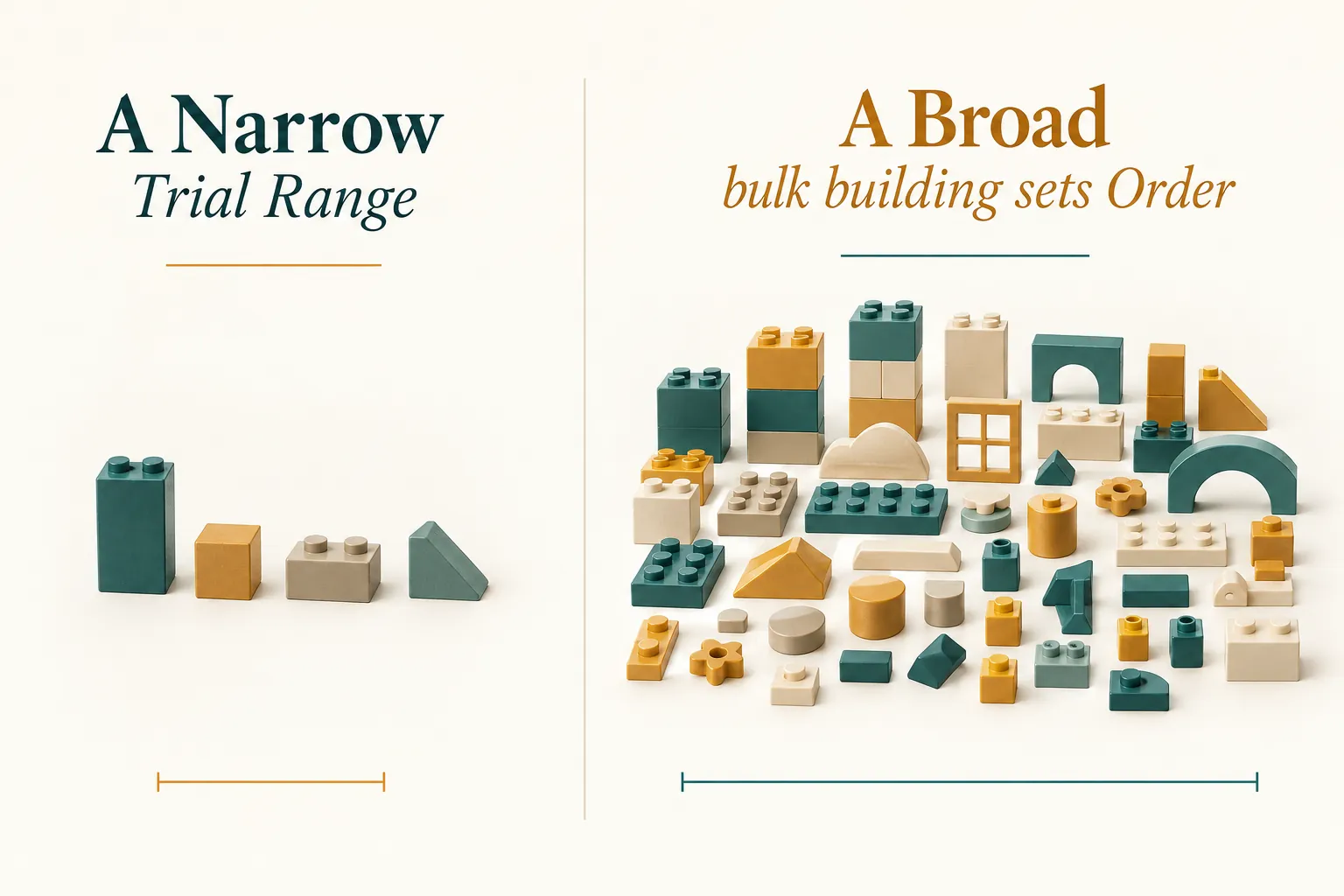
Which recorded SKU fits a trial, and which fits a bulk commitment
| SKU TBS-291358 — bioplastic construction block truck and car set, 50 pcs | Mechanism: brick building (push-together blocks). Recorded material: plastic. Sales unit: single item. Reference MOQ: 36. Units per carton: not recorded. Recorded weight: 2.0 kg. Best role: trial SKU — low entry quantity, variant still easy to adjust, but you must confirm carton packing before a bulk repeat. |
|---|---|
| SKU TBS-274003 — ejection ball run set with 3 changeable shapes, marble race track | Mechanism: non-magnetic buildable ball-run track with ejection action. Recorded material: plastic. Sales unit: color box. Reference MOQ: 240. Units per carton: 48. Recorded size 28×10×22 cm; recorded weight 2.0 kg. Best role: bulk SKU — carton count is on record, so order quantity can be planned in full cartons. |
| Decision rule | Trial the SKU with an unrecorded carton count and a changeable variant; bulk-order the SKU with a recorded carton count and a frozen variant. |
| What neither record proves | Certification status, safe age grading, licensing, current price, available stock, factory capacity and delivery time are not established by a catalog record. |
Why piece count is the wrong basis for a bulk order
A 50-piece truck set and a multi-shape ball-run set are not comparable by piece count, and piece count does not set your order quantity. The order quantity comes from the sales unit, the reference MOQ and units per carton — three separate fields. TBS-291358 records a reference MOQ of 36 with no carton count; TBS-274003 records a reference MOQ of 240 with 48 units per carton. Those numbers describe order documents, not the toy inside the box.
Two arithmetic traps follow. First, a reference MOQ is a minimum, not an order multiple — unless the supplier states a full-carton restriction, you are not obliged to round every order up to a carton. Second, a master-carton dimension is not a parcel dimension; if a record only gives a single-item size, do not back-calculate carton volume from it. Ask for the master carton measurement and gross weight in writing before you quote freight.
For TBS-274003 the arithmetic is at least checkable: at 48 units per carton, 240 units is five cartons. Whether your supplier treats 240 as a floor or as a multiple is a commercial term you confirm, not something the catalog implies.
The trial worksheet: what to verify before you scale
A trial run exists to confirm unit cost, cycle time and quality targets under real production conditions, not to prove that a factory can hit a number Supplier Ally. Keep the trial narrow and score it against fixed criteria so the bulk decision is evidence-based rather than a feeling.
Score each trial SKU on: connection mechanism as built (not as described), variant accuracy against the approved sample, piece inventory counted from the sealed box, sales unit and packaging format, instruction sheet clarity for the target age, and approval evidence held separately from supplier declarations. A supplier's statement that a product is certified is a declaration, not verified compliance — the test report, its scope and the tested construction are what you actually review.
Expect friction on small runs. Low trial quantities can sit behind bulk orders in a supplier's queue, delaying key materials and components, and special parts are harder to pull quickly Supplier Ally. Plan the trial calendar with that lag built in rather than assuming trial speed. Reported examples of unusually small runs — a factory supplying 200 units for testing, or a Shenzhen factory absorbing color and logo changes between two trial runs at no extra cost — are anecdotes tied to those factories, not a standard MOQ or a standard customization term.
Approval sequence: trial range first, bulk release second
Sequence matters more than order size. Step one: freeze the mechanism and variant for the trial SKU and order the reference MOQ or the smallest quantity the supplier will quote. Step two: inspect the sealed trial units against the worksheet above and record the actual piece count, packaging and instruction quality. Step three: only for SKUs that pass, release the bulk order — and size it from units per carton, not from a round number.
Where a carton count is missing, the bulk release waits. That is the honest reason TBS-291358 reads as a trial candidate and TBS-274003 reads as a bulk candidate in the same snapshot: one has the packing data you need to plan a container, the other does not yet. Getting the carton spec in writing is a one-email fix, and it converts a trial SKU into a bulk SKU.
Keep the two tracks financially separate too. Trial spend buys information; bulk spend buys margin. If a trial SKU passes, your repeat order is a new commercial negotiation — price, MOQ and packing should be reconfirmed, because a trial quote is not a standing price.
Buyer questions on splitting a trial from a bulk order
Can I place a bulk order for a truck building set without a trial?
Yes, if the connection mechanism is already proven in your assortment and the variant is frozen. The trial is a substitute for experience, not a legal step. What you should not skip is written confirmation of the sales unit, units per carton and master-carton dimensions, because those drive freight and storage cost.
Does a reference MOQ of 36 mean I must order 36 units?
A reference MOQ is a minimum quantity, not an order multiple. Unless the supplier states a full-carton restriction, you are not required to round up to a carton or pay for surplus units. Confirm the term in writing.
How do I size a bulk order when units per carton is not recorded?
You cannot size it accurately yet. Request the master carton measurement, gross weight and units per carton, then plan the order in whole cartons. Until that data exists, treat the SKU as a trial candidate rather than a container commitment.
Is a supplier-declared certificate enough for the bulk release?
No. A declaration is not verified compliance. Review the test report itself, check that the tested construction matches what you are buying, and confirm it covers the destination market and the age group you intend to label.
Should the trial and bulk orders use the same variant?
Only if the trial variant passed unchanged. If you alter color, logo or piece count between runs, treat the change as a new approval point — reported cases of factories absorbing such changes at no cost were tied to specific factories using modular molds, not a general rule.
Sources
- Small-Scale Trial Production Management Prove Mass Production Faster - Supplier Ally