
Separate packaging approval from product approval when a building-toy SKU can retain the same toy and instructions while its box, tray, or carton changes. Use two linked decisions: one accepts the product revision; the other accepts the packaging revision. In the hypothetical scenario below, product revision P1 remains approved while packaging revision K2 is assessed separately. Bulk release names the accepted combination, so approving new artwork does not silently authorize a different toy, pack quantity, or instruction booklet.
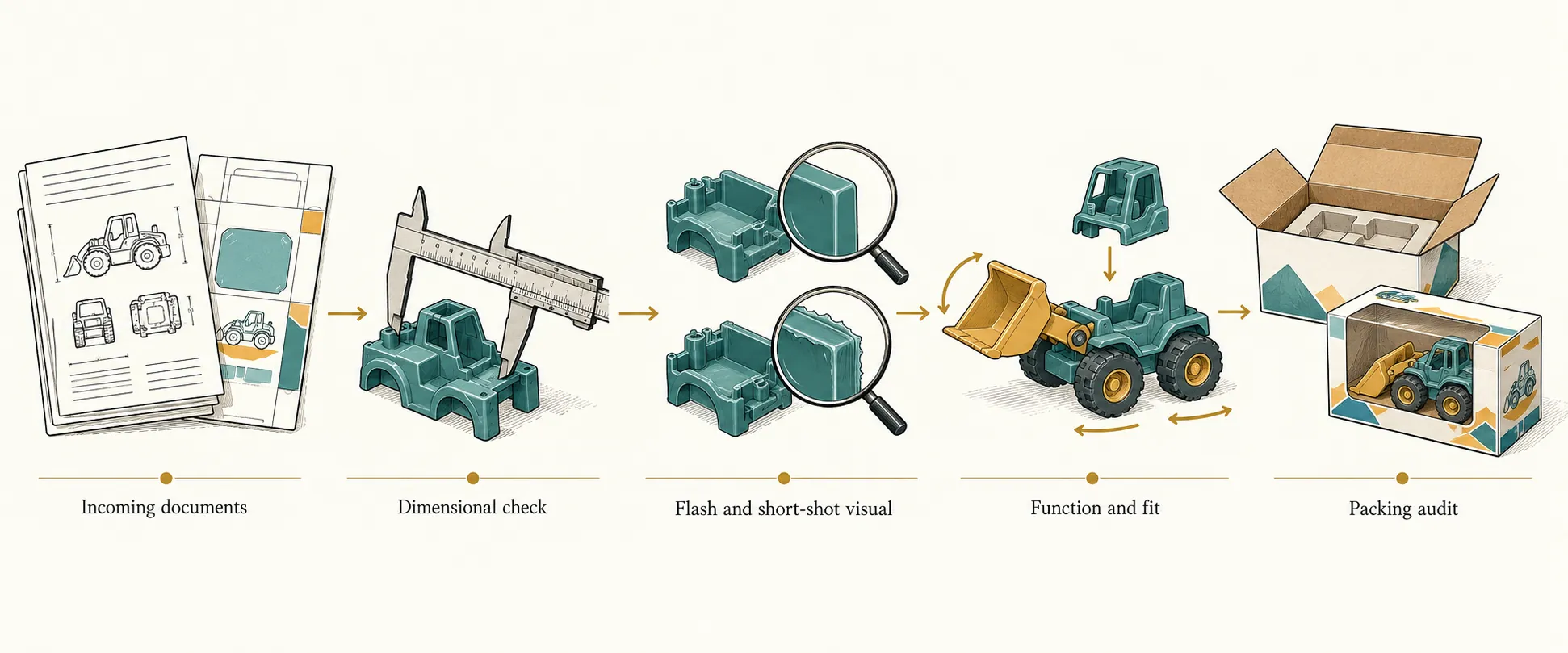
What does each approval gate decide?
The product gate accepts a defined toy and instruction revision; the packaging gate accepts how that approved product is presented, contained, and packed.
For the product gate, identify the variant, construction system, component inventory, assembly instructions, and retained reference sample. Record the checks performed against that reference, such as component counts, assembly fit, and whether the instructions describe the supplied parts. A supplier statement that nothing changed belongs in the record, but it is not a buyer observation.
For the packaging gate, identify the selling unit, artwork, retail box, inner tray, shipping carton, carton markings, and packing configuration. Check the packed sample as well as the artwork file: a correct drawing does not establish that the physical tray holds the bags or that the box closes properly.
Link both gates through the same item identifier, but give each its own revision and decision. Adopt this separation when packaging can change independently. For a fixed, unchanged configuration, one combined record can be adequate—provided product and packaging acceptance remain explicit.
How does the hypothetical brand handle a packaging-only change?
| Approve K2; retain P1 | Illustrative finding: the checked contents match every line of the P1 inventory; instructions match I1; the printed proof matches the artwork master; the packed sample meets the agreed fit and closure criteria. Record packaging approval for K2 and identify P1 + I1 + K2 as the accepted combination. |
|---|---|
| Hold K2; retain P1 for its original configuration | Illustrative finding: the supplier proposes changing the selling unit or units per shipping carton without an accepted packing specification. Hold the packaging decision until the buyer accepts the configuration and checks a packed sample. A carton-count change alone does not require reopening the toy decision. |
| Reject the submitted K2 sample; retain P1 | Illustrative finding: the physical box carries a different variant description from the approved artwork master. Reject that packaging submission and request a corrected, newly identified revision. The mismatch does not by itself invalidate the approved toy. |
| Reopen the affected product approval | Illustrative finding: the new tray requires a part substitution, the kit contents change, or assembly instructions are rewritten. Review the affected product and instruction revisions as well as the packaging. P1 remains a historical approval, not authorization for the changed configuration. |
What belongs in the one-page two-gate approval record?
| Shared identity and record revision | Enter the buyer’s item identifier, variant, supplier item reference, intended selling unit, approval-record revision, and order or sample-request reference. Identify the physical sample and dated files being assessed. |
|---|---|
| Product gate — revision baseline | Name the product revision, construction system, component-inventory revision, instruction revision, and retained reference-sample identifier. In the hypothetical case, these include P1 and I1. |
| Product gate — specified targets | Attach the agreed component quantities by inventory line and the assembly or function checks to be performed. Identify the acceptance criteria before examining the submitted sample. |
| Product gate — observations | Record counted quantities against each inventory line, the assembly steps checked, observed discrepancies, checker, date, and photograph or worksheet reference. State the scope of the check; do not imply that checking one sample verifies the entire order. |
| Product gate — supplier statements | Record the supplier’s declaration of changes or no changes, who supplied it, and when. Keep this separate from counts, measurements, and comparisons performed by the buyer or inspector. |
| Product gate — decision and signature | Enter approved, conditionally approved, held, or rejected; identify the accepted revision and permitted next action. Record the responsible product approver’s name and decision date. |
| Product gate — condition closure | For each condition, identify the required correction, responsible owner, due date, closure evidence, closing reviewer, and closure date. State whether the condition blocks further sampling, bulk production, or shipment. |
| Packaging gate — revision baseline | Identify the packaging revision and its artwork, retail-box drawing, tray drawing, carton specification, and carton-marking master. Link it to the accepted product and instruction revisions. |
| Packaging gate — configuration targets | Specify what constitutes one selling unit, its contents, units per inner pack where applicable, and selling units per shipping carton. Keep component count, order quantity, and carton quantity in separate fields. |
| Packaging gate — dimensional targets and observations | For each relevant retail box, tray, and shipping carton, record the drawing’s nominal dimensions and agreed tolerances beside measured dimensions and units. Identify internal versus external dimensions, sample identity, measurement date, and checker. Do not substitute parcel dimensions for shipping-carton measurements. |
| Packaging gate — physical and printed checks | Record the packed-sample fit and closure result, actual pack count, printed variant and barcode comparison, and carton-marking comparison. Reference the checked physical sample, artwork proof, and photographs separately. |
| Packaging gate — supplier statements | Record declared packaging changes and any statement that the product, inventory, or instructions are unchanged. Identify the supporting submission without treating the declaration as a physical inspection result. |
| Packaging gate — decision and signature | Enter the packaging decision, accepted revision, permitted next action, responsible packaging approver’s name, and decision date. Distinguish approval of an artwork file from approval of a packed physical sample. |
| Packaging gate — condition closure | List each correction, owner, due date, required proof, closing reviewer, and closure date. Require a corrected proof or sample appropriate to the condition; an acknowledgment alone does not demonstrate correction. |
| Combined release and supplier acknowledgment | Name the authorized product, instruction, and packaging revisions together; specify sampling, bulk production, shipment, or reorder scope. Record the release owner, date, remaining restrictions, and supplier acknowledgment of the exact revision combination. |
How do the two decisions control sampling, bulk production, and reorder?
Authorize each stage explicitly; approval to make a packaging sample is not approval to produce or ship the finished order.
During sampling, allow the supplier to make the identified K2 proof or packed sample while P1 remains the product reference. Before bulk production, accept the applicable product and packaging revisions and close every condition that blocks production. Keep shipment-blocking conditions visible if production is authorized before they close.
For the hypothetical held case, the handoff would identify P1 and I1 as retained, K2 as held pending acceptance of the packing configuration, and packaging resampling as the only authorized next action. It would name the person responsible for resubmission and the buyer responsible for closure. No bulk release would be implied.
For reorder, reference the last accepted revision combination and obtain a change declaration. Compare the relevant order samples and packing evidence against that baseline. A previous approval provides a reference; it does not establish that the current shipment matches it.
What does the approval record actually establish?
The record establishes what was reviewed, which revision was accepted, who made the decision, and what action that decision authorized.
Its reach follows the evidence recorded. An artwork proof supports an artwork decision; it does not establish physical tray fit. A checked sample supports observations about that sample, not an automatic conclusion about every later unit. Revision identifiers and supplier acknowledgments support traceability, but cannot by themselves reveal an undisclosed substitution.
Neither gate alone proves toy safety, legal compliance, age suitability, or future shipment conformity. Keep applicable product and market documentation in the wider purchasing file. A delivery term such as FOB, CIF, or DDP allocates trade responsibilities; it does not certify the toy.
Two-Gate Approval Decisions
When should a packaging change reopen product approval?
Reopen the affected product checks when the change alters components, construction, kit contents, assembly instructions, or another accepted product characteristic. Also review any packing method that could alter the parts. Artwork or carton-marking changes alone can remain within the packaging gate, with appropriate review of their content.
Who should sign each gate?
Assign the product gate to the person accountable for the accepted toy specification and the packaging gate to the person accountable for the printed and packed configuration. One buyer may hold both roles, but should sign two distinct decisions. Name a release owner to authorize the combined revision set.
How should conditional approval be closed?
Describe a verifiable correction and its release restriction, then assign an owner and due date. Close it only after the named reviewer accepts the required evidence and records the date. For example, a corrected artwork proof can close a text correction; a tray-fit correction calls for evidence from a packed sample.
What if the supplier does not use revision identifiers?
Assign buyer-controlled identifiers to the submitted files and physical samples, then obtain supplier acknowledgment of those exact references. A dated filename or sample photograph can help identify a submission, but the release should still name the complete accepted product, instruction, and packaging combination.